An article ran in the New York Times a few weeks ago about some researchers in Singapore who set out to build a robot that could conquer “one of the hardest human tasks”. Part of the article headline won’t be a surprise to you since I already told you the general idea. But the other part of the headline was a surprise to me. Maybe I should just quit dissembling though and reveal the headline:
I wasn’t too sure who thought that assembling IKEA furniture was one of humanities hardest tasks: the New York Times, or the researchers in Singapore. I know there are lots of people who aren’t crazy about assembling IKEA furniture, but I don’t think it’s very high on the list of challenging tasks for humans, so I forged ahead and did my own survey of ten people chosen at random, asking them what they thought the hardest human task was. These are the answers I got:
1) Building a stargate
2) Repairing a space telescope
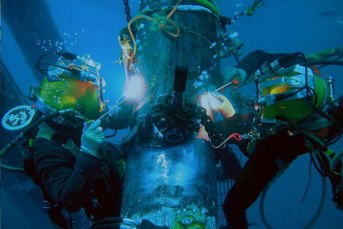
3) Underwater welding
Divers on another planet, welding a submerged stargate on a May 24th long weekend and earning serious overtime pay
Cat attempting to learn the song “Memory” from “Cats” Broadway musical
7) Toilet training a cat
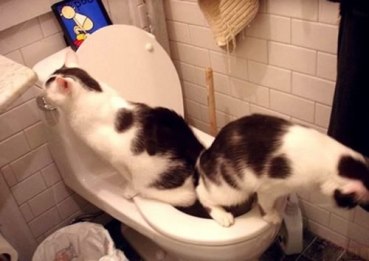
8) Training two cats to use the toilet simultaneously
9) Training a cat to plunge a toilet
Apprentice toilet-plunging cat
10) Trying to understand what would possess a cat to insert itself into a paper tube
Cat trying to be inconspicuous until its owners go to bed so it can pilfer sausages accidentally left out on the counter
I don’t know what’s up with all these cat responses. Somehow I guess I just randomly encountered an inordinate number of people who happen to like cats. I don’t blame these people one iota. Cats are hilarious. Maybe I asked the wrong people. I dunno. In my defense, I was in a pet store at the time. But I also want to point out the distinct lack of people in my survey who said anything about IKEA furniture.
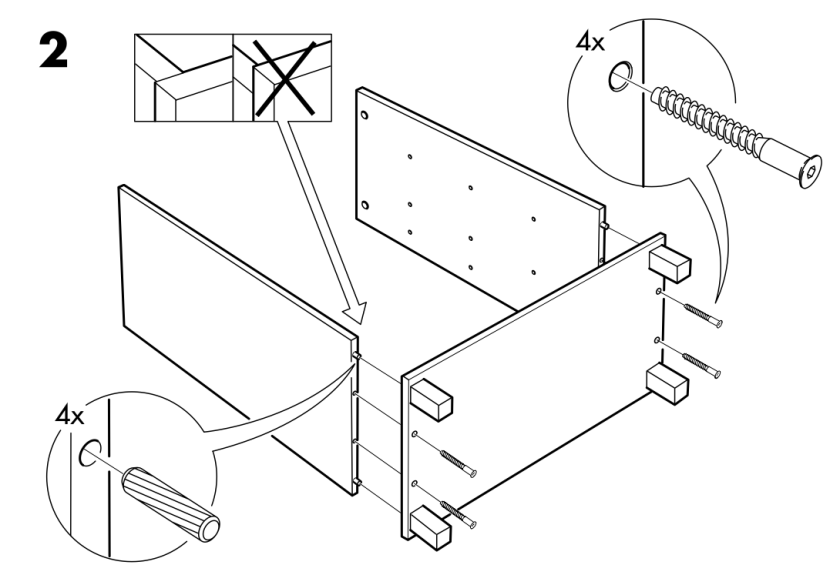
Anyway, for whatever reason, these researchers over in Singapore decided to build a robot that could assemble a piece of IKEA furniture, specifically the STEFAN chair, reasoning that this would use many human skills such as: planning, reading instructions, ignoring instructions, subsequently messing around for thirty minutes until your wife says “Just read the damned instructions would you?”, overdriving the fasteners and damaging the furniture pieces, swearing, and throwing the pieces around or possibly throwing something else such as a unicycle.
Actually, the group in Singapore are not the first group to construct a robot that can assemble IKEA furniture. Back in 2013, a team at MIT built an “IKEAbot” that was able to assemble the LACK table. Note that the LACK table is so-named because it lacks complexity: it has only five pieces. Four of them are screw-in legs. A baby hamster could assemble a LACK table. Or maybe a baby octopus.
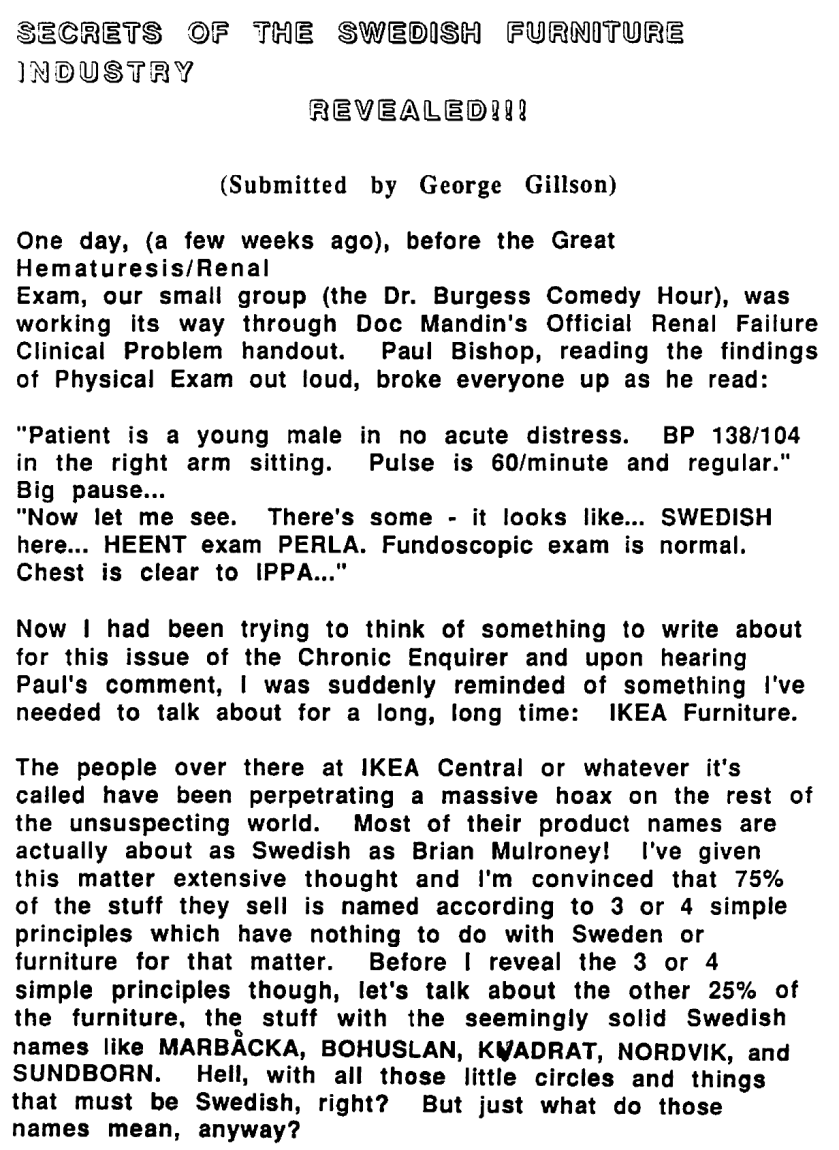
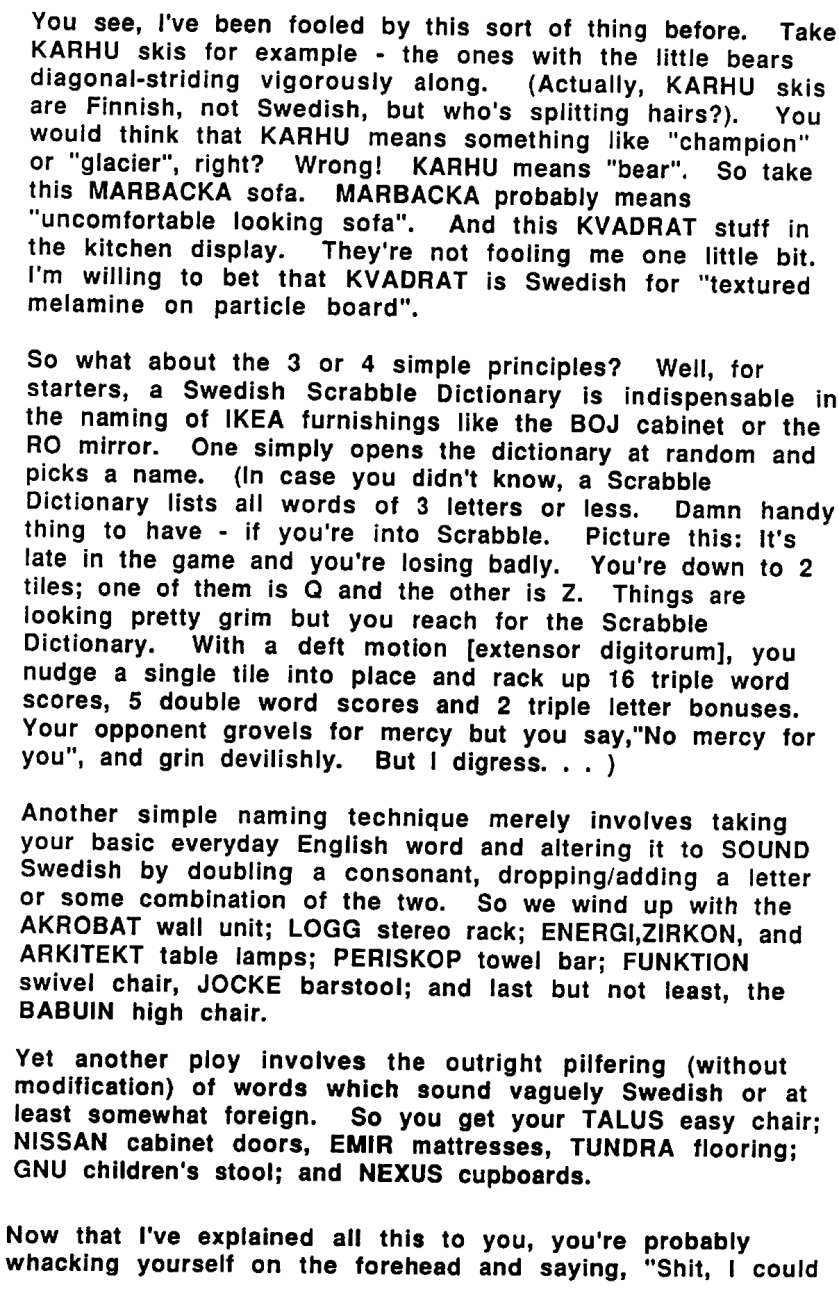
This reminds me. Did you ever wonder how they name IKEA furniture? I did. I even wrote about it back in 1989, in my first year of Med School. It was in the class newspaper: The Chronic Enquirer. I think it was one of the first humor columns I ever wrote. (I use the archaic term “humor column” because blogs hadn’t been invented yet. Remember that the World Wide Web had just come out of Labour and Delivery in 1989.)
I probably should have quit while I was ahead. But I didn’t.
Therefore, here’s that column, inside jokes and all:
Typical good, clean, Swedish shenanigans at IKEA furniture-naming fest: October 28, 1988
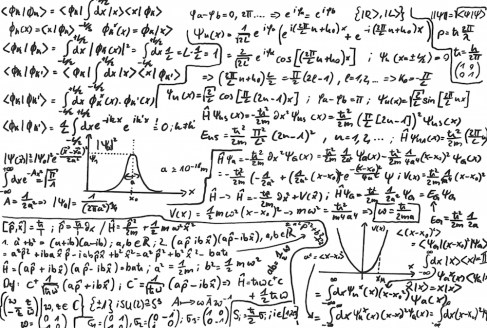
Shortly after they colonized Earth and devised the Theory Of How To Sort Laundry Without Anyone You Happen To Be Married To Getting On Your Case, Quantum Physicists busily set about trying to devise a Grand Unified Theory (GUT) which would merge the electromagnetic, weak and strong interactions into one single force. The notion behind this was that if the GUT could then be coupled with the gravitational interaction (aka gravity), this would produce a Theory Of Everything or TOE for short. These two acronyms could then be rearranged into another acronym: GET OUT, as in: “Get Outta this galaxy! That is one badass theory.”
Quantum Physicist Richard Feynman with a somewhat different haircut than the one he had in the photo on his Los Alamos ID card
But decades later, the TOE still eludes them.
What happened? Well unfortunately, along with a large number of regular human beings, the Quantum Physicists got sidetracked once their kids started taking dance classes.
Anybody who has kids in dance knows that it’s a cutthroat and hectic business come competition season. Your kid might be in as many as six different dance competitions throughout the months of April, May and possibly part of June. And if you have more than one kid in dance, the complexity of driving them all over the place and watching all the various dance numbers rapidly becomes overwhelming. Even to Quantum Physicists.
Typical logistics planning for dance competition season
Then there are the awards. Each competition seems to have a different hierarchy of medals that are handed out. To save time, I’m just going to focus on the medals for the highest awards. In one competition, first place would be a Gold medal. Makes sense, right? Gold was probably good enough for the Greeks when the Olympic Games started 2,784 years ago. And it’s still used for first place in today’s Olympics.
But in another competition, the highest award might be Platinum. And in yet another one, Titanium is the highest award. It’s so confusing, especially when you start looking at the Periodic Table.
Recall that the Periodic Table organizes the elements into rows and columns according to the structure and size of the atoms. The atomic number reflects the size of the nucleus: bigger atomic number, bigger nucleus. Simple, right? So there’s no way that Titanium, coming in way down at atomic number 22, should take precedence over Platinum (atomic number 78) or Gold (atomic number 79).
That’s my point. See how easily I got sucked in? The same thing happened to the Quantum Physicists! They spent too much time trying to figure out the transportation schedules for dance competition season. And when they got done with that, they started trying to devise a Grand Unified Theory of Hierarchification of Dance Medals. So they forgot all about the TOE.
But back to Titanium et al. You can barely give Titanium away. It sells for like $12/kg whereas you are going to fork over almost $30,000 for a kilo of Platinum and over $40,000 for a kilo of Gold. So again, Titanium loses on atomic number AND price. The only thing it really has going for it is corrosion resistance and a high strength-to-density ratio. Big deal.
I feel like Titanium should be banished from the podium. There are lots of other elements that could take its place, like Osmium (atomic number 76) and Iridium (atomic number 77). They’re not making as much Osmium and Iridium as they used to, so as is the case for Platinum and Gold, you and your bank account will be parting ways to the tune of $35,000 to $45,000/kg if you want to score some Osmium and Iridium. And don’t even get me started on Rhodium. Its price can spike up to several hundred thousand dollars per kilogram. I swear on Warren Buffet’s money clip that I’m not making that up.
And there’s always good old Ununennium (aka Eka-Francium). Ununennium, at atomic number 119, hangs out way, way up there in the Periodic Table, on the Island of Stability, where all the Chartered Accountants first settled when they came to Earth. (The Quantum Physicists settled in LA.) Trouble is, Ununennium costs several billion dollars per atom so that would make for some pretty small medals. Plus who can pronounce it?
Dance Competition Judge: “And the High Unending Award goes to…Sorry I mean High Unununennui Award…Whoops! There I go again! The High Underwearennium Award…Crap! One more time. The High Ununennium Award for Lyrical Dance goes to entry number 187: Badass Theory!
Audience: Wild applause and odd biphasic hooting sounds.
Really, at the end of the day, most metals (including Silver!) look similar: silvery, greyish or greyish-blue.
Titanium rodsPlatinum crystalsWeird-looking thing made of pure osmium
Even Theodore Gray, author of the best-seller: The Elements would admit that most of the metallic elements look alike. I think he even says that somewhere, maybe page 123, but don’t quote me.
Don’t get me wrong. This is an excellent book. If you’re into Chemistry. Not that I’m biased
Maybe I’m overthinking this whole thing. Maybe no one besides me cares how the blazes a dance competition chooses to name its medals. The kids in dance work darned hard. They deserve those awards no matter what metal they’re named after.
The Quantum Physicists need to get back to work devising a TOE.
Bad-ass Theory might be an OK name for a band.
I obviously need to get a life. And I will, as soon as I check whether hierarchification is even a word. I feel like it should be.
Next column: Robot successfully performs one of the hardest human tasks
In the last few years I’ve noticed that there is no originality in journalism any more. At least in the magazines that I poke my nose into. Yes, I still read words printed on paper, bound into booklets called magazines. These magazines are mailed to me every month or so. Unless someone scoffs them before they make their way into my mailbox. Which happens occasionally. A lack of integrity among mail carriers has developed in parallel with a lack of journalistic originality. We live in a troublesome age.
I read Popular Science, Scientific American and National Geographic. Back in the 80’s I would dread the arrival of Scientific American, because it was approximately an inch thick and it would take me about two weeks to read one issue. Now most of the articles are no longer than three or four pages, and many of them have a distinct political slant.
I’m trying to figure out why National Geographic is still called National Geographic. It used to be about an inch thick and had lots of maps in it. And pictures of people, roads, buildings, animals, fish and birds. Now it’s a lot harder to see the connection to Geography in some of the articles, and many of them have a distinct political slant.
I guess you could say I’m disillusioned with both Scientific American and National Geographic. Or maybe disappointed.
On the other hand, I’m not disillusioned or disappointed with Popular Science. So I’m stopping here briefly to wonder if instead I could say that I’m illusioned or appointed with Popular Science. Probably not. English can be tricky that way.
I think I’ll just say I’m pretty stoked on Popular Science. For starters, it was never an inch thick. And many of the articles have to do with things that a) go really fast b) look super-complicated c) might involve serious amounts of electricity or d) are just generally dangerous to play with.
Anyway, getting back to the lack of originality in journalism, I’ve noticed that if one of the three magazines I just mentioned, such as National Geographic, was to run an article about a topic such as why the hierarchy of medals handed out in dance competitions doesn’t make any sense from a Chemistry standpoint, then sure as shootin’ that same topic will be covered a month or two later in one or both of the other two magazines I just mentioned.
Dance competition medal
I don’t have the space here to get into this whole dance medal hierarchy/Chemistry thing because I really want to talk about Ornithology, and in particular I want to talk about the intelligence of birds.
Ornithologist (left) looking quite pleased with career choice
Birds are smart.
Take your basic pigeons for example. If a pigeon runs across one of those fake plastic owls it will figure out in pretty short order that that owl is bogus. Meanwhile you shelled out how much for thing. $29.95? No bird would pay $29.95 for a sham owl. That’s for sure.
And what about this? Just recently I was musing out loud about Normal versus Lognormal statistical distributions and my parrot suddenly chimed in:
Parrot: “No. Remember that the standard deviation is MULTIPLICATIVE in Lognormal distributions and ADDITIVE in Normal distributions.”
Me: “Shit! You’re right. What was I thinking?”
Parrot: “I dunno. May I have another cracker?”
Me: “Yes, if you can answer this riddle: What did the mathematician say when he lost his parrot?”
Parrot: “Polygon.”
See what I mean? That is one smart bird.
I probably made that whole conversation up. I don’t actually have a parrot, but I do have a dog and two cats. None of them can talk. And at this point, if I got a parrot to talk to, the thing would likely outlive me. But I’m getting off topic here.
My point is that bird brains are getting lots of air time lately. Earlier this year, both National Geographic AND Popular Science ran articles discussing the intelligence of birds. Coincidence? I think not. This is a perfect example of the current lack of originality in journalism. You thought I was kidding. And bloggers are even worse because they just pick up the stuff that the magazines are copying from each other and replay that to their followers. All fifty-six of them.
The February 2018 National Geographic article entitled: “Think ‘Birdbrain’ Is an Insult? Think Again” had all kinds of great stuff in it though, including a tool-making cockatoo named Figaro and another expert puzzle-solving cockatoo named Muppet, who was described as ” a little, focused engineer”. (If I ever get another pet I think I will name it Muppet. Even if it’s an iguana or worse yet, a Komodo Dragon.)
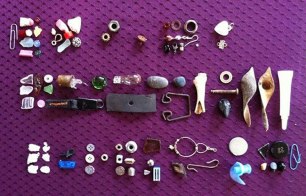
There was also mention of some crows in Seattle who began bringing dozens of trinkets to an 8-year old girl and her brother after they started laying out crow snacks (in the form of dog kibble) in their back yard. The trinkets included Lego pieces, tiny gears, lightbulbs, a tiny Waldo (maybe he’s in the photo below, maybe not), a tube of Crazy Glue, the rubbery insert that I lost from one of my earbuds last year, a discarded intracardiac pacemaker electrode, a small plastic squid (not shown) and a Wenger 16999 knife (also not shown). Note that the crows had to team up to bestow the Wenger, as it weighs approximately seven pounds.
Cockatoo constructing primitive slide ruleTrinkets bestowed on two children in Seattle by a bunch of crows who are partial to dog kibble
As if that wasn’t enough, Popular Science followed suit by devoting their entire Spring 2018 issue to intelligence of all sorts: human, animal, robot, car and sentient public washrooms. The cover featured a crow that was reputed to be smarter than your 5th grader. On page 104 of that issue, I also learned that crows and maybe corvids in general hold funerals for their departed.
With apologies to Edgar Allan Poe: Quoth the raven:”Nevermore” !
Crow gloating after finishing the SAT in three hours and twenty-seven minutes
This is really great and all, but the best thing I ran across pertaining to birds is some recent research that has determined that birds can see the magnetic field of the Earth. This may be due to special proteins in their retina called cryptochromes. Cryptochrome comes from the Greek meaning “special protein in the retina”.
With the help of cryptochromes, magnetic fields are visible to the birds in the presence of certain wavelengths of blue light. This is due to Quantum Coherence, which may occur whenever a quantum physicist utters a coherent sentence understandable by normal human beings including, but not limited to, Ornithologists. But Quantum Coherence also occurs whenever wave functions “cohere” or have the same phase.
Here is what some theoretical and computational biophysicists think the sky might look like to migrating birds, thanks to Quantum Coherence:
I’m kidding. This is actually what the biophysicists think the sky might look like to migrating birds, especially owls:
No. I’m kidding again.
Seriously, I am really and for true about to show you a picture of what the biophysicists think that birds might see. But first I have to swear on this real picture from the Los Alamos ID badge of iconic quantum physicist and super-genius Richard “Dick” Feynman, that I’m not going to show you another fake picture.
Richard Feynman as a youth, smirking after he finished the SAT in 23 minutes and 12 seconds
Here we go with the real picture. The top series of images somehow represent magnetic fields and the bottom series is the superposition of the magnetic fields onto the bird’s field of vision:
All the bird has to do is keep itself oriented to the desired pattern of brightness. Pretty amazing huh? What is even more amazing is that other creatures besides birds can detect magnetic fields. Alert readers will recall that dogs exhibit a preference for facing north when they poop. And some birds will also help dogs get their “bathroom bearings”:
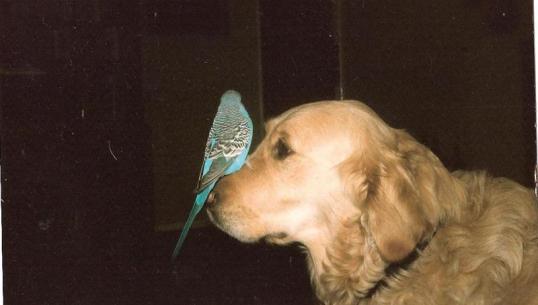
Parakeet whispering to dog: “The bathroom is over there to your right.”
We may not understand them, but we should take our hats off to all the Quantum Physicists of this world, and also to the ones on the Home World of Quantum Physicists.
Better living through Quantum Coherence!
Next column: Robot successfully performs one of the hardest human tasks













 The Department of Lateral Thinking
You must be logged in to post a comment.