Posted in zany, offbeat humor

Home Alone

I think I mentioned a while back that Dave Barry (from whom I have shamelessly adopted many writing techniques) has a Substack, unsurprisingly entitled “Dave Barry“. For a very reasonable yearly fee of sixty Canadian dollars, readers can leave comments, trade anecdotes, etc. You should check it out. That guy is 79, eleven years older than I am, and still cranking out hilarious stuff every two weeks.

In April 2025, Dave put up a post entitled “Marriage and Dementia“. That post was based on a controversial article emanating from Florida State University (Motto: We Forgot Our Motto.) which “somewhat shockingly suggests that unmarried people are less likely to develop dementia“. There are a lot of confounding factors in that study but that aside, it actually may make some sense.

If you aren’t married, no one will accuse you of using the wrong settings on the washing machine; no one will wake you up at night because they heard a weird noise; no one will hog the covers; no one will insist on hanging a gigantic picture of Santa in the living room at Christmas, to temporarily replace the equally huge bison photo that hangs there the rest of the year. Not that I have anything against Santa, or bison.

My point here is that you may have significantly lower stress if there is no one else living in your house, except possibly your dog. Your dog will never give you any grief about the laundry and is always happy to see you. Lowered stress means lowered cortisol and lowered cortisol means less shrinkage of the Hippocampus, conveniently located in your brain. In case you didn’t know, the Hippocampus is not a university named after Hippocrates: it’s the region of your brain involved with “memory formation, learning, spatial navigation and emotional processing”. Shrinkage of the hippocampus is associated with dementia.

Because I’ve been married for a total of almost 45 years now (just not to the same person), I’m certainly looking over my shoulder these days. My recall of trivia and stuff that happened 40 or 50 years ago isn’t quite as fast as it used to be, especially if I’m in a social setting such as appearing live on Jeopardy. But I get by. I’m more easily distracted though, forget where I set down my phone and there are the usual issues of aging that appear no matter whether you share a house or live alone.

Here are some examples:

Usual Signs of Aging Example #1: Loss of Near Vision

Alert readers will recall that I posted about a project which my daughter Alex and I finished in November 2020: Sam’s Study DIY kit. That study was filled with several hundred handmade teensy items such as faux plants, faux books, a tiny Karl Rove action figurine, etc.

Here’s a close-up:

Unable to resist self-flagellation, and also because the Study was eventually ravaged by a pack of marauding Borrowers, Alex and I recently finished another DIY kit: Simon’s Coffee Shop.

It took about four years to complete the Coffee Shop. Having a baby along the way slowed things down somewhat. (To be clear, Alex is the one who had the baby.) Anyway, here’s the finished project, which also has some teeny books but mostly features myriads of indescribably teensy items painstakingly glued together from even teensier bits of things.

And here’s a close-up:

For some reason, I feel like Sam and Simon are probably related: identical twins, possibly. Or at least, fraternal twins. And you’re probably wondering what all this has to do with aging. What it has to do with aging is that I don’t recall having had issues assembling Sam’s Study but I definitely needed help reading the instructions for Simon’s Coffee Shop with the aid of my granddaughter Sophie’s toy magnifying glass. Word got out to my son Drew, who promptly turned around and gave me these LED-assisted, goggles complete with a set of magnifying lenses (not shown) for my birthday:

I think they’re actually pretty righteous but maybe a little daunting if worn at night around small children. I think I’ll leave the porch and house lights off and wear them on Hallowe’en though.

I have another set of goggles that are less daunting but sadly, they don’t illuminate or magnify. If I ever take up bee-keeping though, I’ll probably wear them.

Usual Signs of Aging Example #2: Easily Distracted

One morning a few weeks ago, I needed to take my dog, Sarge, to have him groomed in Okotoks, a town about 45 minutes south from where I live in North Calgary. I was running around trying to get out the door on time and was distracted because I was trying to co-ordinate with friends at a golf course while Sarge was getting his makeover. I also had to do a fifteen-point turn to back out of the garage because my wife Jeanette’s vehicle was occupying the center of the driveway, which didn’t help.

Anyway, I left the house and bombed down the main highway. Forty minutes later I was turning on to the off-ramp leading to the town. I shoulder-checked for some reason and was struck by the horrible realization that I had left Sarge at home. Alone. (Honest mistake: most of the time, Sarge just flops down in the back seat and doesn’t surface until we stop moving.)

I pulled over and called Liz, the groomer:

Me: Liz, it’s George. I’m just coming into Okotoks. You’re not going to believe what I did.

Liz: What?

Me: I left my ##5?!**$ dog at home!

Liz: Helpless laughter.

When she stopped laughing, Liz said she had done a similar thing on several occasions, told me to go home, fetch Sarge, and come back. Which I did. I was able to drop Sarge off, meet up with my friends and then fetch Sarge -whose tufted, pointy Grinch feet were no more- and headed home. On the way, I called Alex.

Me: Alex, you’re not going to believe what I did.

Alex: What?

Me: As I was exiting off Highway 2 to Okotoks, I suddenly realized that I left Sarge at home.

Alex: Dad. Ohmigod!!! (Helpless laughter ensued, lasting well over a minute.)

Fortunately, all is well. Jeanette didn’t insist that I undergo an immediate cognitive evaluation. She laughed at the magnifying goggles. And yesterday I happened to be watching the 2001 John Cusack movie Serendipity and out of nowhere, without even trying, I suddenly remembered that the female lead was Kate Beckinsale. So there’s hope. Of course, if you looked like her and were also a female, I’m pretty sure people would never forget your name:

In closing, I’ll leave you with this comment I made in response to Dave’s 2025 “Marriage and Dementia” post and for some reason, that post is still getting likes fifteen months later. So there’s more hope. Here’s the comment:

“There’s also actual sharing of sensory organs. My wife is short-sighted and at night she has to locate large objects, such as our house, by touch. I, on the other hand, don’t wear glasses; my near vision is still pretty good in strong light. So I’m the seeing-eye husband. My hearing has lost a lot of bandwidth though, thanks to listening to too many bands, such as the Rock Bottom Remainders*. Plus I had my left eardrum surgically replaced when I was 27. (I’m not making that up.) Consequently, I can’t hear worth shit. However, my wife is the all-seeing ear-not to mix metaphors. She can hear me setting the dial on the dryer from two floors away and instantly knows if I used the wrong setting. All that aside, thankfully we still have our hair. And our teeth.”

*In case you didn’t know, Dave Barry plays in a band called the Rock Bottom Remainders. He’s the one on the left and he still has lots of hair. Not sure about the teeth.

The Rock Bottom Remainders band

Posted in zany, offbeat humor

How I’m Spending My Summer Vacation

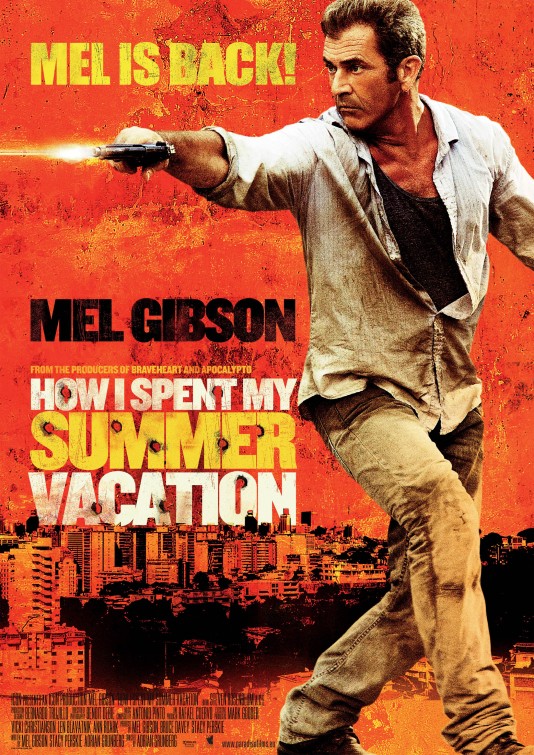
The Summer is just getting started up here, north of the 49th Parallel but from where I sit it’s looking like it’s going to be a long one. I’m talking about the length of Summer, not the length of the 49th Parallel. But since you brought it up, the 49th parallel makes up almost 1300 miles of the US-Canada border. File that piece of useless trivia away and instead, consider the feature image for this article, a promotional poster for the 2012 movie “How I Spent My Summer Vacation” which starred Mel Gibson, Meryl Streep, Julia Roberts, Jane Fonda and a long list of people I’ve never heard of.

To SEE exactly what the actual i’m going to write about in this post, keep reading
Posted in zany, offbeat humor

Let There Be Light. Light Emitting Diodes, That Is.

A couple of months ago I noticed that two of the four LED bulbs in one of the light fixtures hanging over the island in our kitchen had gone dim (but not out). Two more bulbs in the fixture hanging in our foyer also went dim (but not out). Note that foyer does not rhyme with lawyer. In true Canadian fashion, foyer is pronounced “foy-eh”. So, it rhymes with sashay or whey or “go away”. Just saying.

One of the attributes of lightbulbs, LED or not, is color temperature or hue (warm, cool, etc). The unit of measurement for hue is the Kelvin. The Scottish fellow who invented the Kelvin scale for temperature measurement was actually named William Thomson. He was a mathematician, physicist, engineer and a pretty righteous eel-fisherman who lived near the river Kelvin. Eventually he was ennobled as Lord Kelvin, in part for his contribution to developing the first and second laws of thermodynamics but also for his contribution to the grand unified theory of dance competition medals and his recipe for sauteed eel.

Great-great-great-great-great-great-grandson of Lord Kelvin.

I bring color temperature up only because my dim bulbs (which were made by an outfit called SATCO) were rated at 3000K (whitish). I bought a few 2700K (somewhat yellowish) bulbs to vet as possible replacements for all the remaining 3000K bulbs but they didn’t pass muster: too yellow. I ordered more 3000K bulbs from SATCO but a couple of them also went dim after a short while. Coincidence? I think not. So. I started poking around.

Back about 20 years ago, a company named Lights of America was sued for false advertising and had to fork over millions of dollars to disgruntled customers whose bulbs were failing at an alarming rate and were definitely not outperforming incandescent bulbs as claimed. But there have been no LED-related lawsuits since then.

So. I started poking around again, by actually reading the disclaimers on the LED bulb packaging. Most manufacturers consistently quote a maximum lifetime of 13 or so years if the LEDs are lit for 3 hours/day. Lit for 9 or 10 hours/day, the bulbs would probably last 3 to 5 years and most manufacturers warrant their bulbs to last that long. That seemed reasonable. But I still didn’t know why my bulbs weren’t lasting that long.

In that ancient, iconic movie, Sleepless in Seattle, Tom Hanks has this to say to his son, Jonah, regarding his new girlfriend, Victoria (Barbara Garrick in case you were wondering): “Jonah, listen to me. You don’t know Victoria. I hardly know her myself. She is a big mystery to me. She tosses her hair a lot. Why does she do this? I have no idea. Is it a twitch? Does she need a haircut? Should she use a barrette to keep her hair out of her face? These are things I’m willing to get to the bottom of.” 

Victoria minus a barrette

Just like Tom, there are things that I, too, am willing to get to the bottom of. Not that I’m anal or anything. So, I poked around yet again, to understand these bulbs better.

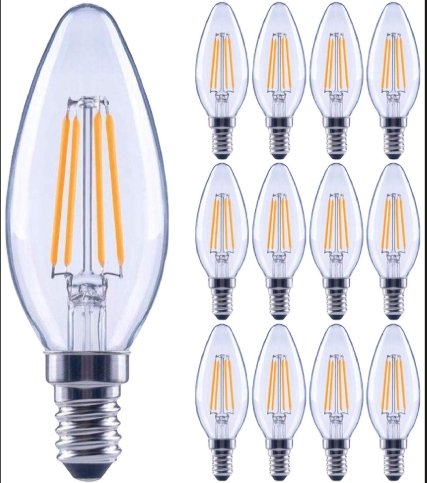
LED bulbs get hot: just not as hot as incandescent bulbs. Fifty to seventy percent of the electricity fed to the yellow LED strips/”filaments” winds up as heat (compared to more than 90 percent for incandescent bulbs). Here is an example of the LED candlelabra-type lightbulbs that inhabit the fixtures hanging above the island in my kitchen. Correction: in my wife’s kitchen which I am occasionally allowed to occupy when I pass the “Why are you even in this kitchen right now, anyway?” test.

The yellow strips are strings of tiny LEDs coated with a substance that turns the blue LED light to yellow – or white light

Ironically, though they’re not that efficient, incandescent bulbs can last for decades, maybe centuries even. Recently, an incandescent bulb was found still burning in the basement of an Egyptian pyramid. It (the bulb) was estimated to be at least 4000 years old. Below is a tablet found next to the bulb, warranting the bulbs lifetime for 6000 years, give or take. Time will tell.

Don’t believe everything you read though, because fake news is everywhere. Just ask Kevin O’Leary

Anyway, hieroglyphics aside, along with the heat generated by the LEDs, additional heat emanates from the tiny chips that lurk down in the base of the bulbs; these chips mind their own business, busily converting 120V AC to a few volts DC. Bless their little hearts.

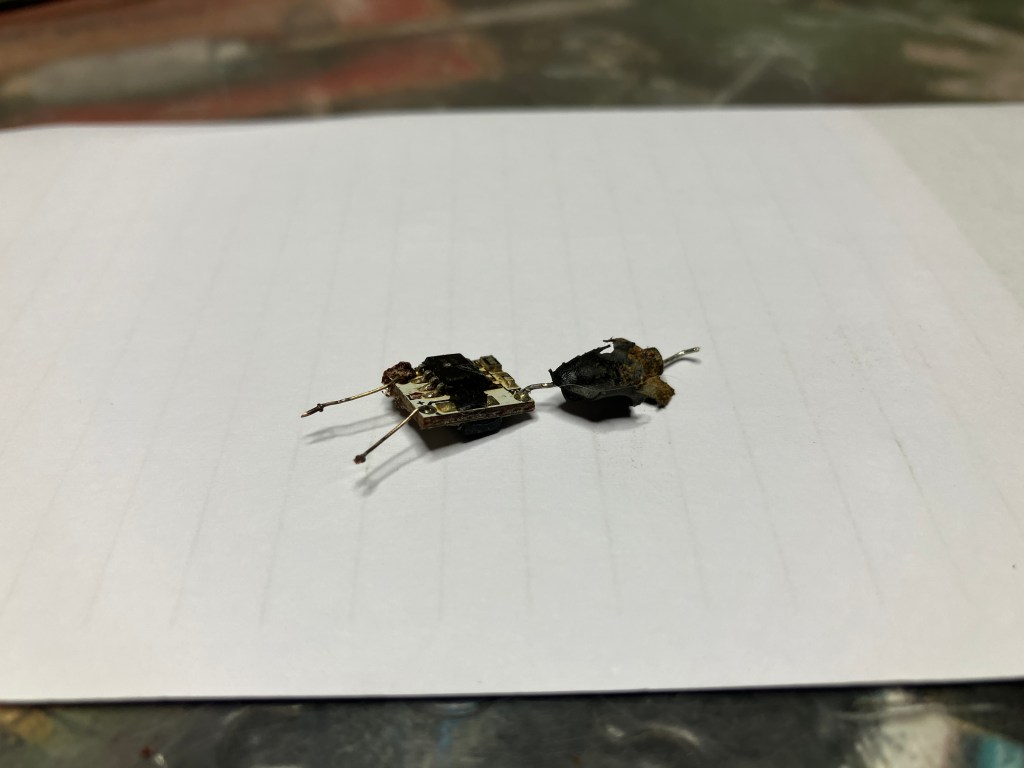
Here’s a view of one such chip, minding its own business and hoping it’s not going to be extracted. It’s easy to see how that thing can fry itself if it gets too hot, as the heat can get trapped in the base.

Sorry. I couldn’t resist extracting that chip. Enquiring minds want to know.

To recap, I initially went off half-cocked about this whole business. LED bulbs weren’t that well-made or reliable two decades ago. The manufacturers now know a thing or two about a thing or two and today, for the most part, LED failure isn’t due to shoddy manufacturing. I still wouldn’t buy bulbs that are ridiculously inexpensive though. Buy bulbs that have a manufacturer’s warranty.

If your LED bulbs fail, it’s likely the fault of the fixture. You can’t take just any LED bulb and stick it into just any fixture. Some fixtures trap heat more than others and this can result in LED failure inside of a year. Trust me on this. Buy bulbs that are “enclosure-rated”. They’re built to take the heat.

Sermon ended but I must say one more thing. I don’t want to leave alert readers dangling.

Full disclosure: this post was intended to be about a professional strong man who believes he has become the first person in the world to pull a car with his genitalia-while on fire. I just couldn’t figure out what actually was combusting: was it the car, the man’s Johnson, or some other body part?

Dangling modifiers, such as “-while on fire” are the bane of responsible writers. Clarity is everything.

Posted in zany, offbeat humor

Craggy Island Calculus Problem v.2

This was first published May 11, 2015.

For the sake of argument, say that you happen to be standing on the edge of a beach off the coast of Ireland, directly facing a little island called Craggy Island. Fans of the British television series “Father Ted” will be getting excited at this point, since Father Ted and his fellow renegade priests were exiled to Craggy Island due to some unspecified but nevertheless unsavory behaviour.  But more on that some other time.

Where was I?  Oh yes!  For some inexplicable reason, you have been seized by a powerful urge to kayak to the island, despite warnings about sharks. Sharks aside, you also don’t know the distance to Craggy Island. How could you determine the length of your impending voyage?

Personally speaking, I would just call the Craggy Island Department of Tourism and Limpets (1-877-LIMPETS) and ask them how far it is to their island.  But maybe there’s no answer when you call and maybe you just don’t like taking the easy way out.  So now what?

Well…if you happen to know how fast the lighthouse beacon is rotating, and if you happen to know how fast the beam is sweeping toward you when it hits the (eerily-straight) shore 1/2 kM north of where you’re standing, you could say to yourself: “This sounds like a related-rate problem!  I might be able to use Calculus to solve it!”

220px-triple_integral_example_2-svg

Since you have nothing better to do, you resist the urge to start paddling, so you fly home and spend the next few nights covering page after page with chicken scratch, basically re-deriving Calculus from first principles, since you haven’t used it for 38 years or so.  (The picture which should pop into your head at this point is that of a large beetle flipped over onto its carapace in front of a blackboard, feebly waving a piece of chalk clutched in its foreclaw.)

beetle-on-back

Finally, your son takes pity on you after witnessing your struggle and says, “Dad, why don’t you just Google it?” Since you were born well before Al Gore invented the Internet, you look at him with a dumbfounded expression and reply, “What the heck would I Google?” Your son regards you with a sorrowful expression and says, “I dunno.  Google is pretty clever. Try typing: ‘Calculus Lighthouse Problem’.” You dutifully follow this directive and to your undying amazement, the search returns a long string of hits and one of them even refers to Craggy Island!

From there it’s just a short hop to a YouTube video clip (Calculus tutorial) made by an endearing fellow named Bart Snapp who solves your problem right before your very eyes!  You really should watch this clip, mostly because I took the trouble to transcribe the intro almost word-for-word, but also because you will find yourself swept away by Bart’s patently obvious love of teaching in general and Calculus in particular. Also, this guy is great at reading out loud. I quote:

“Hello there!  Now we’re going to do a problem (waves hands energetically) about a beacon in the ocean, also known as a lighthouse of sorts.  But we’re going to call it a beacon.  All right?

“All right!  Let’s see the problem! (Reads problem enthusiastically and eloquently.)

“All right.  So we have our problem and now we have to… (he pauses for dramatic effect)…Draw a picture! (Bart starts sketching rapidly on a whiteboard)

“All right.  So we have a, we have the shore here and the shore’s supposed to be straight.  (Draws more-or-less straight line)

“Well.  Well that’s straight enough I guess.  Here’s point A.  (Draws the beacon on a line perpendicular to point A, and presses on)…the beacon has some light that is shining and let’s see… (adds some more notations like dϴ/dt and dx/dt to his diagram).

“What else?…Aha!

“And the water…This is all supposed to be water here.  (Draws blue squiggles.)  That’s great.”

And really, it is great because at that point you see that the beacon, the place where you’re standing directly opposite the lighthouse, and the point where the beam hits the shore 1/2 kM north of you, form a triangle, and you can relate the rotational speed of the beacon (in radians/sec of course) to the sweep rate of the beam along the shore, through trigonometry!

lighthouse

From there it’s only a matter of a couple more days of calculations until you figure out that the lighthouse is 1 kM straight out from where you’re standing.  You can easily handle a 1 kM paddle but then you remember that the last person who tried it was eaten by sharks.  What should you do?

The first thing you should do is ask yourself whether this whole eaten-by-ravenous-sharks while-attempting-to-paddle-to-Craggy Island thing is true or is it an urban legend?  And does Craggy Island even exist, or is it the product of the imagination of a couple of half-baked Irish writers named Arthur Matthews and Graham Linehan?

This is important because urban legends are everywhere these days. Consider the story I read recently about an intoxicated Marine in the state of Kansas who was arrested after a failed attempt to foil his car ignition interlock by having a raccoon breathe into it.

Right away you have to be suspicious that this is an urban legend because there are no raccoons (or Marines for that matter) in the state of Kansas.  Actually, I’m lying.  I made up the Kansas part, and if you consult Google, you will discover that Kansas is literally teeming with raccoons.  I quote from the Kansas Department of Wildlife, Parks and Tourism website: “Highly intelligent and adaptable, the raccoon (Procyon lotor) is one of our most abundant furbearers. “ But all that aside, your first clue that the story is b.s. is that everyone knows Marines don’t drink.

Anyway, the point is that you have to be careful not to waste your time on drivel like the story of The Raccoon and The Breathalyzer. Instead I want you to recall The Owl and The Pussycat, a poem by British artist, illustrator, musician, cookbook author and all-around oddball Edward Lear (1812-1888). In a tribute to Edward Lear and Craggy Island, I rewrote the poem.

owl-and-pussycat

With apologies to all the people of Britain, except King Charles:

The Owl and the Pussycat did some maths, with the aid of Barton Snapp
They related dtheta to dx (by dt) but they found themselves in a trap
They set forth for the Isle but in a short while, the water began to boil
Attacked by a shark, in the cold and the dark, off shuffled their mortal coil(s).


Well, it’s time to shut this thing down.  I’m going to heat up a plate of leftover limpets and then get ready for my paddle to Craggy Island first thing in the morning.  But just one nagging thought remains:

I think I’m going to need a bigger boat.

bigger-boat

Posted in zany, offbeat humor

Boolean Algebra as Applied to The Zombies (and RVs)

A couple of years ago we bought a 22-foot RV trailer and we’ve had lots of enjoyment out of it. That said, every year, the trailer still has to made ready for “RV Season” and this involves putting the batteries back in it, filling propane tanks, draining antifreeze out of the plumbing, checking tires and dealing with the cover that has enshrouded the trailer over the winter. Come Spring, that cover is as dusty as the Sahara and has to be cleaned and stored until Fall. It’s sort of a PTSD-inducing experience.

Anyway, two days ago I was en route to the place where the trailer is stored, pondering over what the heck I was going to write about for this month’s post. Suddenly it occurred to me that I should write about the ins and outs of RV camping!

Canadians and Americans love to camp. Witness the number of people in larger cities on both sides of the border who live outdoors all year round! Sarcasm aside, as of 2024, there are about 2 million people up here in O Canada who own an RV trailer or maybe a full-size luxury RV bus. In the U.S. around 10 million households have an RV. The Brits are also enthusiastic about taking to the roads in “motorhomes” or “caravans”. Interestingly enough, the 60’s and 70’s made up the Golden Age of Caravans and Camper Vans in Britain.

Continue reading “Boolean Algebra as Applied to The Zombies (and RVs)”
Posted in zany, offbeat humor

Material World v.2

This post was originally published on November 9, 2015.

These past couple of millennia, many people have been thinking that here on Earth we are way too attached to the material plane of existence.  Consider the sheer panic you experience when you can’t find your wallet or glasses, and the corresponding relief you feel when you touch your hair and say, “What the hell is my wallet doing in my hair?”

Even worse, what about when you’re on Mars, minding your own business when suddenly you’re seized by a feeling of overwhelming vertigo and say, “OMG, where’d I park the MAV?”  (MAV stands for Mars Ascent Vehicle aka spaceship.)  But then just as suddenly, a sense of peace washes over you as you say to yourself, “What the heck.  It’s just a spaceship.  I’m getting way too attached to the material plane of existence.”

That realization helps you to get a grip and remember that you parked the MAV in the second crater to the north, not the fifteenth crater to the southwest. So it’s all good.

crater
This looks like the face of a giant alien. It looks like it is alarmed by something. It also needs a haircut. Its left eye may have been damaged by a meteor strike or something. It has a big mouth and no teeth. It looks like it is clenching a honking big cigar in its mouth or maybe it’s a baby lemur. Same difference.

That was ridiculous.

Where was I? Yes! Materialism! Things could be a lot worse.  You could have a piece of an antenna protruding from your thorax, your crewmates could have ditched you, taking the MAV with them, and you could be stuck on Mars for the next two years with nothing to eat but potatoes.

the-martian

Anyway, my point here is that this feeling of missing something that’s actually not missing is pretty common, and maybe it has something to do with being over-attached to the material plane of existence. Or not.

But first, consider this conversation between you and your sister: about a U.S. Marine who tried to use a raccoon to spoof the on-board breathalyzer in his car:

You: “So, Sis, then the Marine says to the State Trooper, ‘Was I speeding Ossifer?’ to which the State Trooper replies, ‘Why do you have a raccoon loose in this vehicle?’ ”

Your sister: “That sounds like Fake Raccoon News but text me the link anyway.

You: “Sure.  I’ll do it right now.”

You reach for your cellphone and for a moment, a wave of unadulterated terror sweeps over you when you can’t find it.  But then you realize that you’re actually talking into your phone as you search.  There’s a medical term for this phenomenon called: Dude You’re Way Too Attached to Your Cellphone.

There’s another everyday cellphone-related occurrence called Phantom Vibration Syndrome in which you experience the illusion that your phone is vibrating when it’s actually minding its own business, continually broadcasting your location, pulse rate and shoe size to agents of The Department of There’s A Lot of Stuff Going On That You Don’t Know About So Just Don’t Ask OK?.  There’s a fairly complicated explanation of how the illusion works, involving your microbiome, time travel and a few other concepts but the long and short of it is that you’re way too attached to your cellphone.  At least your peripheral nervous system is.

And speaking of being attached to material things, here’s yet another everyday example:  Once again you’re sitting there on Mars, eating your breakfast of potatoes.  Or maybe it’s lunch.  Or dinner.  Or a snack.  Or another snack.  Anyway, you’re sitting there thinking about the starch you’re downing, and how your blood sugar is rising, and that in turn your insulin is rising and that you have another 583 days of eating potatoes to contemplate. Suddenly you’re seized by an almost otherworldly (!) sensation of loss, and you think to yourself:

“Insulin?  Insulin?  OMG, where’s my pancreas??”

Image result for pancreas-389623

But again, a sense of calm returns when you say to yourself, “No! Wait. What was I thinking?  It’s one of my internal organs! Phew!!”

There’s also a medical term for this and it’s called Reading Way Too Much Stuff About Paleo Diets.  Or maybe it’s that other medical term: Martian Women Don’t Eat Potatoes But Even If They Did, They Wouldn’t Get Fat.

Last but not least, there’s that weird thing that happens when you’re standing on your treadmill at work and you start poking icons on the screen of your desktop computer and then wonder why nothing is happening on your phone.  Or you’re punching numbers into your cellphone and wondering why nothing is registering on your desktop screen.

Of course there’s a medical term for this and it’s called: Not Every Computer In The World Is Made By Apple, And By The Way. That’s Your Cellphone Not Your Keyboard, Numbskull Syndrome.  No, seriously.  There is a bona fide medical term for futilely poking your desktop screen and it’s called Touchscreen Illusion Syndrome.  You would think that these medical writers could be a tad more creative when they’re naming these syndromes.  But that’s not my point.

My point is that I’m running out of descriptors (sheer panic , overwhelming vertigo, unadulterated terror, otherworldly (!) sensation of loss) to express the distress we all feel when we can’t find our stuff.  It’s starting to make me a bit edgy.  I don’t know if there’s a name for getting panicky thinking about getting panicky, but before we know it, we’re all going to be wandering around wondering if we’re way too attached to the material plane of existence, patting our pockets to make sure our cellphones are still there and worrying about our insulin.

I think everybody needs to just sit down and have another French Fry.  And another.  And another…

potatoes
Posted in zany, offbeat humor

Sasquatch Update

As we all know, Sasquatches are reputed to be incredibly strong, shaggy, shy creatures who walk upright like humans, pay no taxes, make weird hooting noises at night and don’t like to have their picture taken. As a result, virtually every picture of a Sasquatch is grainy and indistinct.

Sasquatches have popped up in a number of my posts over the years so given the successful completion of the Artemis II mission and in keeping with the tradition of boldly going where no man has gone before, I decided it was time to boldly go forth into the Land of the Sasquatch as seen through the lens of the Lateral Thinking Department Time Telescope. Here goes…

To find out more, Keep Reading
Posted in zany, offbeat, somewhat silly humor

Toilet Seat Lore v.2

This post is a revision of the original which appeared on September 24, 2015. I’m replaying some of the older posts because I can’t for the life of me figure out how to display the posts in folders by year which would make it much easier for people to browse. As it is, there’s a list of about 115 posts in chronological order. Nobody bothers diving down to the bottom of the literary swamp. Anyway, here goes:

Well, it looks like I’m cranking these things out somewhat less often than I’d like to but echoing the immortal words of John Cusack explaining to his prof why he was late to class in the cult movie: The Sure Thing (1985): “Well you see there was this problem and I’m late because of it.”

The problem is that a few weeks ago we woke up one morning and decided to adopt a seven-year-old border collie named Mickey. Everything you read about border collies says they need to have a job, so Mickey’s job is to play fetch 23 hours a day and look at me reproachfully the rest of the time.

So, between Mickey and the treadmill, there’s not a lot of spare time these days. Plus, I didn’t have anything worth writing about until last week when we had visitors from LifeLabs head office, aka The Mothership. (LifeLabs bought my lab in 2013 but kept me on as Medical Director until 2023, for some reason.)

OK, where was I? Yes!

For the sake of argument, I’ll call refer to one of the visitors from The Mothership as: “Lisa Kearns” (not her real name).

“Lisa” was telling one of the people with whom I share an office what a great stay she had had in the Hotel Elan (otherwise known as the Hotel Elan): “a unique, business-friendly boutique hotel in Calgary, located uptown just off vibrant 17th Avenue SW.”

hotel-elanI wasn’t sure what a boutique hotel was so I Googled it.

A boutique hotel is: “a small stylish hotel, typically situated in a fashionable urban location.”

I read a few more Google results and found a pearl of wisdom from Kobrun Vidisdottir, of Reykjavík, Iceland.

According to Kobrun, a boutique hotel is: “an accommodation that makes their guests feel happy and contented while staying there, makes them feel extraordinary, makes them to realize that they should revert soon and makes them to recognize that this hotel is worth discussing with others.”


I followed most of what Kobrun was trying to say but I got stuck at the part where she started talking about reverting. Reverting to what? Her maiden name? Windows 7? Human form? Then I figured out she meant return soon.

That reminds me! I should return to the theme of this post, which is supposed to be about toilet seats. Therefore, I will now commence talking about them. Just don’t forget to remind me to tell you a little bit more about Reykjavík before I sign off.

Our visitor, “Lisa”, was going on about the heated and lighted toilet seat in her hotel room, which in her words, “changed my life.” I asked her if her life routinely involved sitting on ice-cold toilet seats and she said no, the heated seat was just a particularly pleasant experience. The underside of the seat was festooned with blue LED lights which, apparently, were also pleasant.

Now this is important because everyone knows that if you wake up in the middle of the night and turn on a yellow or orange light, it will immediately shut down your melatonin. Everyone also knows that the last thing you want to do is sit on an ice-cold toilet seat and shut down your melatonin when all you really want to do is take a pee and go back to sleep. But I guess it’s this kind of thing that separates a normal hotel from a boutique hotel. I think it’s still sort of surreal though, like going to the bathroom in 2176 AD.

Speaking of going to the bathroom in 2176 AD, Calgary happens to have a few choice, futuristic, public washrooms (FPWs) strategically located around the city. I had the chance to use one a few years ago but to refresh my memory about it, before I started writing this post, I paid a visit to an FPW near my house, at the Tuscany LRT station. (My house is not at the Tuscany LRT station; the FPW is at the Tuscany LRT station.)

toilets-1

For starters, the FPW was pretty futuristic-looking. You approach the door, push a button, the door slides open and you find yourself in a little room with a lot of stainless steel including a stainless-steel toilet, with no toilet seat.

first-button

You push another button (“Toilet Seat”) which triggers a bunch of disturbing mechanical noises. A panel in the wall slides open and a toilet seat deploys from behind the panel, spraying liquid in the process. (I am not making any of this up.) You half-expect that some robot arms with metallic claws will appear, seize your eyelids and pry them open, like in “A Clockwork Orange.” A mellifluous robotic voice guides you through the whole process, accompanied by a stirring rendition of “The Ride of the Valkryies.” (Kidding.)

second-buttonYou go to into the FPW and happily, if you can’t figure out how to flush, there are instructions to help. Once you wash your hands, the toilet seat folds back into its nook, the panel slides back down and you’re good to go. (I thought you just went.)

third-button

But say you’re still sitting down or just remaining immobile for some reason: shock probably. The mellifluous robotic voice comes back on and tells you that you have about 20 seconds until the cubicle door opens, unless you start moving around soon. If you don’t move around fast enough, the voice starts counting down. Seriously.

I actually filmed the whole thing and you can check it out here:

(Futuristic Public Washroom video clip)

My son Ty got quite panicky in an FPW once, when the mellifluous robotic voice announced the countdown while he was still working on going #2 or whatever. Maybe it was #2.6. I dunno. Anyway, Ty lept up from his perch and began waving his arms madly, gaining the precious seconds he needed to finish his business.

The whole setup is just so weird that I fully expected to emerge from that washroom to find myself catapulted two or three centuries past 2176 AD and coming face to face with a Dalek or else “Robot” from Lost in Space. “Danger, Will Robinson! Danger!”

verdarobbyFor the heck of it, I started looking at high-end toilets and found one which automatically deploys a menacing-looking probe from somewhere in the bowels (pun intended) of the toilet bowl. The probe emits a gentle spray of water which you direct with a complicated remote control. Since I can barely use my TV remote, I probably won’t buy one of those probing/spraying commodes, even if I could afford one. I’m saving up for a time machine.

Last but not least, if you happen to have to go potty in O’Hare Airport in Chicago, brace yourself. When you’re in the cubicle, you press a button on an apparatus situated on the back of the toilet. You hear mechanical noises and then a protective plastic sleeve shoots out and telescopes around the toilet seat.

You do what you went in for, then get up. After more mechanical whirring noises, the sleeve retracts back into the apparatus behind the toilet seat.

My only question is: what happens to the sleeve you sat on? Is it discarded or is it sent back around for the next unsuspecting victim? I know, I probably shouldn’t worry about these things but I can’t help feeling that life is getting way too complicated here in 2015.

Maybe I should just move to Reykjavík even though there are a shitload of consonants in Iceland. Quoting now from Randburg.com (whatever that is) about the downtown area: “The old city center is atmospheric and relaxed. Many excellent cafes, bars and restaurants are located there and there are also many shops, including stores specializing in traditional souvenirs and stocking a good selection of merchandise, including crafts, Viking spears, ceramics, jewelry, toilet paper, playing cards, books, golf tees, calendars, Avaxtskyr cheese, sheepskin products and Iceland’s famous woolen underwear. “

Sounds great. I’m fresh out of Viking artifacts, so I’ll definitely check Reykjavík out.  But I bet the toilet seats are freezing in Iceland.

Posted in zany, offbeat humor

Time Well Wasted

For many people, retirement opens up more free time which is often filled by taking up pastimes such as: traveling, golfing, bank robbery, pickleball, unicycling, glaring and muttering at teenagers who walk down the street glued to their phones, gardening, managing investments, collecting crystals (minerals), going to their grandkid’s sporting events and fixing stuff around the house. (Apparently even retired chimpanzees are fascinated by crystals.)

I do some of the above activities, especially fixing stuff but I also like to build electronic gadgetry, such as this little solar-powered beetle-like “robot” that makes its way toward sunlight and can navigate around objects. That thing is 30 years old and my oldest son vividly remembers playing with it. At some point in that 30 years the gadget stopped working and languished immobile in my workshop until I recently unearthed it and repaired it.

Now it’s as good as new and is in the possession of Felix, one of my grandkids.

Dad: What do you think, Felix?

Felix: “Pretty good”

This next video features a little, solar-powered wooden triplane that also languished in my shop until recently.

I was curious about exactly how fast the plane was going so I timed it and determined that it was making about 22 revolutions per minute. Knowing the diameter of the circle it was tracing, I reckoned that the plane was moving at about 4000 feet/hr, give or take. This works out to be about 0.8 miles/hour.

“Hmmm,” I thought, “I wonder what that would be in Mach numbers?” Mach numbers are typically used to rate the top speed of things like jet fighters and also possibly Tom Cruise’s top speed, when he does his trademark sprinting scenes in his movies. Why does he do that? I don’t know.

Mach 1 is the speed of sound. Mach 2 is twice the speed of sound. Mach 3 is three times the speed of sound. And so on. I looked up the speed of sound at sea level. It’s 767 miles/hour. Therefore, my little triplane at 0.8 miles/hour is going Mach 0.001.

I don’t know what Tom Cruise’s top end is when he’s sprinting. I know that in 2009, Usain Bolt clocked in at 27.8 miles/hour in the 100-meter sprint. His sprint only lasted 9.58 seconds. I don’t think Cruise can go that fast.

As I typed this, it occurred to me that maybe somewhere, out there, people have devoted themselves to an intensive study of Tom’s sprinting. And they have! Check out this Rotten Tomatoes site: The More Tom Cruise Runs, The Better His Movies Are: We Did the Math | Rotten Tomatoes

According to the article, the farther Tom runs, the higher his Tomatometer Score goes! No one knows exactly why, though. I swear on Usain Bolt’s jockstrap that I’m not bullshitting you. Read the article if you don’t believe me. It also says Cruise probably runs at about 10 miles/hour.

That’s Mach 0.0125, in case anyone asks you.

Anyway, here’s a list of the ten longest distances Tom has sprinted. The average Tomatometer score for these movies is 76.5% whereas the average score for sprints shorter than 500 feet is only 60.5%. Go figure.

Top Tom Cruise Movies (According to his pedometer)

  1. Mission: Impossible III – 3,212 feet
  2. Mission: Impossible – Ghost Protocol – 3,066 feet
  3. Mission: Impossible – Fallout  2,628 feet
  4. Mission: Impossible – Dead Reckoning, Part One  2,131 feet
  5. War of the Worlds – 1,752 feet
  6. Mission: Impossible – The Final Reckoning – 1,606 feet
  7. Minority Report – 1,562 feet
  8. Mission Impossible – Rogue Nation – 1,518 feet
  9. The Firm – 1,241 feet
  10. Edge of Tomorrow – 1,065 feet

Of course, in Maverick, the sequel to Top Gun, Cruise didn’t sprint much but he did push the envelope to Mach 10 in a hypersonic jet. In his defense, if I was in his flight suit, I would go for Mach 10 too.

All this talk about Mach numbers and suchlike got me thinking again so I started digging around to see who holds the current land speed record. The land speed record only includes contraptions that don’t go airborne. The current record is held by a now-retired British fighter pilot named Andy Green. Green set the record in what was basically a rocket on wheels known as the Thrust SSC. Green’s October 15, 1997 two-run average (out and back) in the Black Rock Desert was Mach 1.02. That record still stands.

Here’s what Green drove, I mean, almost flew.

That thing was powered by, and here I’m quoting, “two Rolls-Royce Spey turbofan engines, as used in British F-4 Phantom II jet fighters. The twin engines developed a thrust of 223 kN (50,000 foot-pounds) and burned around 18 litres of fuel per second.”

Andy to Mrs. Green: “Hey Hon, I’m going to get some milk. I’ll be back in 3.2 seconds. Unless I run out of gas.”

Eat that, Jay Leno! (In case you didn’t know, Jay Leno has 181 Collector cars and almost as many motorcycles in his 140,000 square foot garage.)

Well, here we are at the end. Some people (and primates) might think that converting the speeds of various people and things into Mach numbers or collecting cars or crystals is a waste of time.

Personally, I think it’s time well wasted.

Posted in zany, offbeat humor

Corpus Callosum v.2

Note: First posted on August 13, 2015

I know, I know.  Every columnist on Earth has written about the differences between men and women, but I still feel the need to dip my oar into this particular literary pond.  But don’t blame me; blame Downton Abbey.

Alert readers (all three of you) will recall that a while ago, I ditched my office chair and started standing up at work. This foray into standing all day was followed by working while walking on a treadmill all day but then I had to start watching Nashville every night to recover from walking all the time.  I’m still walking on that treadmill but am faced with the problem of how to maintain my recovery strategy once Nashville finishes.  (Damned Netflix!)

Happily, Signals catalogue came to the rescue.  Over the past several years, every time I leafed through Signals catalogue I would see all this Downton Abbey paraphernalia such as T-shirts, snuff boxes, Keep Calm and Get a PhD in Neuroanatomy coffee mugs, and gold-embossed toilet paper. I kept thinking to myself: “What’s up with all this Downton Abbey paraphernalia?”  So finally, out of sheer curiosity, my wife and I started watching Downton Abbey every night, which is probably why this post is overdue.

For those of you who just emerged after 62 years in an underground nuclear fallout shelter, Downton Abbey is an award-winning British television series which chronicles the saga of the nobility and the servants thereof, who inhabit a gigantic English manor house called Downton Abbey.  The series starts circa 1912 but I don’t know when it ends because, so far, Netflix only goes up to Season IV.

My point in all this is that back in 1912, especially in England, men and women were still regarded as fundamentally different species, with drastically different proclivities, voting rights and sleeping quarters.  In order to get to the bottom of this polarization, researchers at that time started peering at human brains (after the owners died) in order to decipher whether XX or XY chromosomes affected brain structure.

Speaking of brains, I can’t resist putting this in:

ATTORNEY:   Doctor, before you performed the autopsy, did you check for a pulse?

WITNESS:      No.

ATTORNEY:   Did you check for blood pressure?

WITNESS:      No.

ATTORNEY:   Did you check for breathing?

WITNESS:      No.

ATTORNEY:   So, then it is possible that the patient was alive when you began the autopsy?

WITNESS:      No.

ATTORNEY:   How can you be so sure, Doctor?

WITNESS:      Because his brain was sitting on my desk in a jar.

ATTORNEY:   But could the patient have still been alive, nevertheless?

WITNESS:      Yes, it is possible that he could have been alive and practicing law.


Where was I?  Well, as we all know, the brain has two halves or hemispheres.  The right hemisphere, conveniently located in the right side of your skull, is more concerned with verbal skills and intuition, e.g. the right brain might think to itself: “I have a hunch that my lawyer speaks Norwegian.” The left hemisphere, cozily ensconced in the left side of your skull, has more to do with logical thinking, but also football, so the left brain might think to itself: “I just can’t deduce, why in Heaven’s name, the Patriots underinflated all those footballs in the AFC Championship game. What were they thinking?”

Now, in addition to the “upstairs” brain in your head, some people including Michael Gershon MD think that the enteric nervous system or ENS, a collection of nervous tissue conveniently located in your midsection, qualifies as a sort of “downstairs” brain.  By the way, this has nothing to do with that other British TV series called “Upstairs Downstairs” which also dealt with the goings-on between British nobility and their servants.I guess this just goes to show you that there’s nothing new under the stairs, or at the bottom of them, so to speak.

I don’t have a lot of space here to get into it, but the ENS is thought to be responsible for helping the colonic flora (aka microbiome) decide whether or not to have a second helping of dessert, and the ENS also helps decide whether the 16-mega-roll chamomile-scented pack of Charmin toilet paper is a better deal than the 48-roll pack of unscented steerage-class toilet paper.  I guess it all depends on whether or not you like chamomile and possibly whether or not you’re out of sandpaper.

But let’s get back to when researchers started peering at the “upstairs” brain in earnest.  A long time ago, somebody decided that it was probably a good idea if information could pass efficiently between the right and left halves of the brain, so the corpus callosum was invented.  The corpus callosum (Latin for “tough body”) is a tough, wide, flat bundle or body of nerve fibers (several hundred million if you’re counting) which connects the two hemispheres, sort of like an I-80 for nerve impulses.  I-80 is actually a great choice for a simile because it runs East-West across the United States.  All East-West interstates end in even numbers whereas all North-South interstates end in odd numbers, in case you were wondering. 

After a bit of peering at brains, these researchers managed to convince themselves that the corpus callosum in biological women is bigger than the corpus callosum in biological men.  So for decades the corpus callosum shouldered a lot of the blame for silly stereotypes such as how women are supposedly better at multi-tasking, communicating with other human beings and devising ever more complicated schemes for sorting laundry, whereas men are supposedly better at giving intense focus to tasks like fixing the adaptive optics on the Gemini Planet Imager telescope out in the Atacamba desert in Chile.  (That is, when they aren’t hiding out in their man-caves, thinking about nothing in particular, especially not how they feel.)

In 1992 author John Gray PhD wrote a book about male-female behavior differences and their relationship to brain structure, entitled “Men Are From Mars, Women Are From Venus.” Despite his PhD in General Flakiness from the now-defunct, unaccredited distance learning institute: Columbia Pacific University, Gray’s book generated a storm of interest and even spawned a line of Mars-Venus dietary supplements. 

Time went on and in 1997, Dave Barry PhD, a Pulitzer Prize-winning journalist, astronomer and musician wrote a book entitled “Dave Barry is From Mars And Venus.”  He did not, to my knowledge, develop a line of dietary supplements but you never know.

Unfortunately, we will probably have to wait for the Mars Mission to launch sometime in the 2030’s, to figure out exactly who is from what planet but meanwhile, we’re starting to get a better grip on our neuroanatomy.

The results of recent well-designed research, involving detailed magnetic resonance imaging of the brains of large numbers of (living) males and females of all ages, is taking some heat off the corpus callosum.  Turns out there are definite gender differences in the shape of the darned thing but these differences may not mean a whole lot.  Instead, we’re starting to look at general brain wiring patterns: how much traffic is on I-80 (left-to-right) and how much is on I-75 (front to back if you’re facing north), regardless of biological sex. 

Turns out we’re all different: some people have more cross-brain wiring and some people are wired for more communication within each hemisphere.  Any given man or woman can have a unique blend of both “wiring diagrams” which may have more to do with early experience, genetics and what sign of the Zodiac you were born under.  (I may have made this last bit up.)

I could go on at length here, but I’m tired of writing about this topic, and even if I wasn’t tired of it, I can’t really think of anything else to say.  I’m also feeling a bit jumpy: I can’t decide if I should walk on the treadmill some more, sort some laundry, or fix the adaptive optics in my telescope. I should probably take a page out of Satchel Paige’s book. Paige, a revered Major League baseball pitcher (or possibly it was Winnie the Pooh), once said:

“Sometimes I sits and thinks, and sometimes I just sits.”

I think I’ll just sit and stare blankly into space (pun intended) for a while. Or maybe I’ll make a spot of tea.  I hear they do that a lot at Downton Abbey.