Posted in zany, offbeat, somewhat silly humor

Superman’s Memory Crystals

Seems to me that at the end of the last column about Octopuses, I threatened to devote this column to interesting facts about border collies.  So let’s take that off the table right now: this column is probably not going to be about border collie facts, although I might segue to some border collie facts at some point.  I haven’t decided yet.

But before I go any farther I want to say for the record that the only reason I watched all 220 episodes of Smallville was to humor a small boy who I’ll call Andrew (not his real name).  Remember, when you’re talking about distance, use farther; when you not talking about distance, use further. Remember also that you use whom when there’s a preposition involved, such as in this sentence: ”Whom shall I give this last piece of  piecaken to?”  And when there’s no preposition involved, use who.

Anyway, “Andrew” and I watched Smallville, which everyone knows is the story of Clark Kent (not his real name) growing up in Smallville, after he plummeted to Earth in an escape pod.  His parents Jor-El and Lara put the baby Kal-El in the escape pod because the star around which their home planet Krypton orbited was about to go nova.  When Kal-El got to Earth he did a lot of stuff including getting a new name and getting an “A” in welding shop.

heat-vision
Welding shop-Day One

He also lifted tractors, rescued Lana Lang and Lois Lane and made it to school on time even when his alarm clock was set for 8:59 AM.  (School started at 9:00 AM in Smallville.)

clark-kent-superspeed-smallville-11191776-300-448
Almost late, but not quite!


When he wasn’t busy rescuing Lana Lang and Lois Lane, navigating his troubled relationship with his friend Lex Luthor (What’s with the LL’s anyway?), meeting his cousin Kara Zor-El aka Supergirl, and battling people from other dimensions, he would often retreat to his Fortress of Solitude and Teen Angst. (FOSATA for short.)

Now we normal teens had to make do with the bathroom, but Clark was fortunate enough to be able to retreat to his nifty hangout located somewhere above the Arctic Circle, when things got too intense between him and his adoptive parents Martha and Jonathan Kent.  (Oddly enough, Jonathan Kent looked eerily like a guy I know named Darr-Ell Jones, but that’s another story.)

We never did find out whether the FOSATA had a bathroom, but what it did have was a veritable forest of these Memory Crystals, which contained all the accumulated wisdom of Krypton, plus holograms of Jor-el and Lara, plus a complete list of all 93 weird forms of Kryptonite Clark would eventually encounter, plus his Kryptonian Social Security number.

So these Kryptonian crystals, no doubt, were the inspiration for researchers at the University of Southampton Optical Research Centre (USORC for short), conveniently located in Southampton, England, to develop Earth versions.  They devised a way to encode huge amounts of information in ultrapure, glassy silicon wafers, which have been touted to last “until the Sun burns out”.  Remember that if I was talking about suns in particular no capitalization is required, but since I am talking about our sun, I use Sun.  Just like if I were talking about the upcoming election for President of the United States (POTUS for short) I would say the Presidential Election, not presidential election. But I digress.

Now as we all know, data storage here on Earth, is an ongoing problem.  Magnetized tape (cassettes, videotape, etc) only lasts about 50 years.  Data stored on chips fares better but is still prone to corruption by radiation, alien electromagnetic pulses (EMPs for short) and high temperatures.

“Honey, where’s our terabyte drive?”

“Dang, I accidentally left it in the oven to keep it safe from alien EMPs.  Bye-bye all six seasons of Downton Abbey.”

But glass lasts a long time, even longer than Styrofoam, but even Styrofoam isn’t going to last billions of years, which is why the USORC scientists focused on etching trillions of bits in the depths of ultrapure, glassy silicon wafers, using a femtosecond laser.

In the words of ORC professor (not an orc) Peter Kalansky: “It is thrilling to think that we have created the technology to preserve documents and information (editor’s note: aren’t documents information?) and store it in space for future generations.  This technology can secure the last evidence of our civilization, including the 2016 Presidential debates, and all we’ve learnt will not be forgotten.  Plus, we’re really into femtosecond lasers.”

(A femtosecond laser emits really short pulses, a lot shorter than the time it takes “Andrew” (mentioned earlier) to pick up his socks after he’s been asked 200 times. )

The technology hasn’t been commercialized yet, but so far the researchers have preserved noble documents including the King James Bible, the Magna Carta, Isaac Newton’s “Opticks” treatise (about optics, oddly enough) and all six seasons of Downton Abbey.

glass-wafer

So all this immediately got me putting together a list of things I want to see preserved in these wafers:

  1. How to make perfect hard-boiled eggs which you can peel without the annoying “Membrane Problem”. This is a non-trivial problem, by the way.  So far my favorite method is The Cold Start, where you carefully place cold eggs into boiling water, then turn the heat down to “the barest simmer” and cook for 13 minutes.  Not 12 minutes or 14 minutes: 13 minutes.  If you have a better way, let me know.
  2. How to sort the laundry so your wife doesn’t get on your case: “NEXT TIME, that needs to washed on the delicate setting, in the tears of a virgin gathered under a full moon, Honey.”
  3. How to plumb your in-floor heating so that you don’t burn out two hot water tanks in five years, not that I’m bitter.
  4. The Octopus Garden Cocktail: take 3 parts gin; add 1 part dry vermouth; shake with ice; strain; garnish with a baby octopus and a black olive; apologize to PETOBO (short for People for the Ethical Treatment of Baby Octopuses)
  5. How to make Dyson vacuum cleaners: For those of you with overt or latent OCD tendencies, Dyson vacuum cleaners are the greatest invention since fire, or maybe Lululemon yoga wear.
  6. Segue Alert!! How to get the stains out of your carpet after you feed your Border Collie a wide variety of foods including shrimp, bacon, steak and chicken: Also not a trivial problem. Use some kind of oxidizing agent plus Dawn dish detergent.
  7. Second Segue Alert!! Border Collies in General:  Did you know that all modern border collies (note the non-use of capitals!) are descended from Old Hemp b. 1893.  “Chaser” holds the world record for vocabulary: 1000 words including: “Stop looking at me with that wired, intense stare.  It’s creepy.”  And don’t forget “Striker” who can open a non-electric car door in 11.4 seconds.  Also a world record, and a strong reminder of the old adage: never turn your back on the ocean.
  8. The old adage: Never turn your back on the ocean.
  9. Extreme German Unicycling or How to ride a unicycle down something you wouldn’t even walk down: I can ride a unicycle, but this guy is basically insane, plus I’m dying to know what he’s saying on the video clip.
  10. This joke: Q: What do you call a part-time band leader? A: A semiconductor!

extreme-mountain-unicycling-02

Clearly, I need more, and better, material for my list.  If you have suggestions, send them to me and I’ll eventually send them to USORC, who will eventually send them to Elon Musk, who will eventually send them into space along with a kick-ass recipe for potato salad, Martian-style.  (This gives me a great idea for a movie, by the way.)

Meanwhile, I’m going to drink a cocktail, spark up my Dyson, vacuum up some fluff and then I might re-watch Smallville: Episode 220. You know, it’s the one where Clark finally gets his pilot’s license…plus a hefty fine from the Federal Aviation Administration. (FAA for short)

1230161-clark_flying_3

Next column: When to spell out a number, and when to just use the number itself.

Posted in zany, offbeat, somewhat silly humor

Octopus Update

I know a lot of you are wondering the same thing I have been wondering lately: exactly what are all the octopuses doing on the ocean floor when we’re not keeping an eye on them?  I’m happy to report that after extensive research by agents of The Department of Keeping Tabs on Octopuses, it’s safe to say that they are doing plenty of interesting stuff.  It’s actually pretty hard to know where to start.

Octopus means “Eight footed” in Greek, so if you’re going to talk about more than one octopus, Greek convention dictates that you use “octopuses” as the plural.  Some people prefer “octopi” or “octopodes”, but to me, octopi sounds like a dessert, and octopode sounds either like some kind of worm or maybe a radio tube.  So I’m using octopuses. And my mother was Greek.  By the way, octopuses have arms, not tentacles.  Tentacles only have one sucker.  Each octopus arm has around 250 independent suckers.  Each sucker is roughly as intelligent as a small border collie.

Octopuses are smart creatures, generally regarded as the most intelligent of all invertebrates even when you include politicians.  They are master problem solvers, escape artists and camouflage experts. Rumor has it that octopuses are even being trained as special operatives by the U.S. Military, due to their unique abilities and powerful brains.

There are myriads of coconut shells lying around in many places on the ocean floor, mostly near places where there are coconut palms, oddly enough, and some octopuses have used this to their advantage. The octopus pictured below is comfortably ensconced in its coconut-shell house, already looking a lot like Casper the Friendly Ghost but still thinking hard about what it’s going to wear for Hallowe’en.
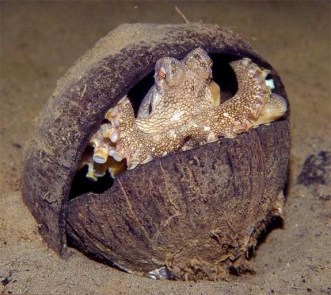
casper-octopus

But there’s more.

Julian Finn, an octopus researcher in Melbourne, Australia, was probably one of the first to report that members of at least one species of octopus have learned to carry two coconut shells around, scuttling about with an awkward gait known as “stilt walking”.

The following is a link to a clip of an octopus in field training as a Navy SEAL (Slimy Eerie Aquatic Leptosome) displaying its ability to seamlessly segue from stilt-walking to defensive maneuvering under enemy fire:   Octopus Stilt-Walking

If you can’t be bothered to watch the clip, here’s a capsule summary: a veined octopus (Amphioctopus marginatus) lumbers along the seafloor, minding its own business and lugging its coconut shells.  Suddenly it stops, hops into one of the shells, pulls the other shell over top itself like a helmet, then rolls off down an incline.

Why did it do this?  No one knows.  Maybe it was late for supper.  And since you asked, supper for an octopus consists mostly of shellfish, which it consumes by “drilling a hole in the shell and slurping out the soft parts.”  I’m not sure how an octopus drills a hole though.

Male Octopus: “Honey, I just broke another drill bit.  I’m going to hop into my coconut-shell vehicle and roll over to Underwater Tool Den for a new one. Don’t wait up.”

Female Octopus (aka “Hen”): OK.  If you wake me up I’m going to peck you mercilessly.

The only thing wrong with that scenario is that octopuses are solitary creatures who only get together to mate.  Sadly, not long after they mate, they both die.  No wonder they’re solitary.

But sometimes the male’s demise is, for lack of a better word, untimely.  People are studying this for a living.  I know, because I found a paper which includes a positively riveting account of a hapless male octopus who was attacked, suffocated, had its ink-sac punctured and was ultimately cannibalized by a hen after mating with her 13 times in 3.5 hours. (That male probably had it coming.)  It’s a great paper which includes some beautiful color photos featuring coral, octopuses and ink-clouds.

inkjet

citation

I don’t know about you, but I happen to think that all this business with the coconut shells demonstrates a pretty fair degree of intelligence.  Man didn’t invent the automobile until the last 150 years or so, but octopuses have probably been rolling around the ocean floor in their shell vehicles since their debut in the Carboniferous Period more than 300 million years ago.  (By the way, the Carboniferous Period is that epoch in Earth’s history when nobody was worrying much about carbon dioxide.)

But intelligent creatures are easily bored, so if you stick an octopus in a tank, you need to give it some stuff to diddle with, otherwise it will probably try to escape. You have to basically weld the lid on to the tank because an octopus can fit through a pretty small hole, as shown in this faintly disturbing video clip: Octopus oozing through a small opening

If it can’t escape, a bored octopus might resort to amusing itself by chewing on things such as one of its arms.  (Don’t worry; the arm will grow back.)  This sounds suspiciously like my border collie, Mickey.  He too, is easily bored and will amuse himself by selecting one toy out of his vast array and worrying at it until all the stuffing comes out.  So far he still has all his appendages though.  From time to time, when I’m bored, I amuse myself by wondering what would happen if you crossed an octopus with a border collie.

When I was trolling the Web for octopus facts, I got to thinking about how people decide how many interesting facts they will post about any given topic.  The first few sites I went to listed an even number of octopus facts.  So I thought hmmm…octopuses have eight arms and eight is an even number.  Maybe I’m on to something here…But then I started running across sites that listed prime, or at least odd numbers of octopus facts: 11, 15, 35.  So much for my theory.

The only thing I can safely conclude is that there are a lot of octopus-fact sites out there, and most of these sites reference a book by Katherine Harmon Courage called: Octopus!  The Most Mysterious Creature in the Sea. I have a copy but I haven’t read it yet.  I think you should get one.  Then you won’t have to rely on me for your octopus information.
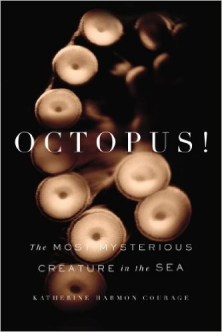
octo-book

Speaking of information, one site I went to noted that octopuses are “limited in their ability to gather information” due to their short lifetimes.  That’s probably a good thing.  Who knows what one would do if it had more information.  Run for President maybe?

There’s a lot more I could get into, such as the copper content of their (blue) blood, their ink, their hectocotyli (don’t ask) and last but not least, the “Dumbo Octopus”.

dumbo-octopus

I’m running out of space, so I’m going to close with a few simple dictums for would-be octopus owners:

  • Never give your octopus access to any books; especially not ones about making weapons.
  • Don’t put a shark you happen to be fond of together with an octopus. A big octopus can break the spine of a shark.
  • It’s OK to have other pets in the house if you have an octopus. I read about an octopus in Thunder Bay, Ontario that was friends with a dog.  Whenever the dog pressed its nose to the tank, the octopus would come up to the glass and change colour: black where the dog’s nose touched the glass, and brown to match the rest of the dog.
  • By the way, if you own a border collie, consider getting an octopus to keep it company. If you have an octopus but no border collie, I might lend Mickey to you.
  • Consider letting your octopus run in the 2020 Presidential election. We could do worse.

Next column: Interesting facts about border collies
Posted in zany, offbeat, somewhat silly humor

Gravity Waves

There’s something that’s been on my mind for quite a while now but I just couldn’t seem to get inspired to write about it.  In addition to seeming like I couldn’t get inspired, I actually couldn’t get inspired.  And if I had gotten inspired, I would have written this already, wouldn’t I?  Just saying.

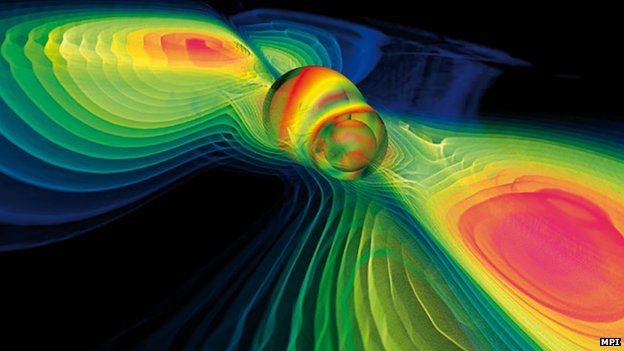
All that changed recently when the detection of gravity waves was announced. I don’t know if it has already occurred to you, but it occurred to me, that The Gravity Waves actually sounds like a great name for a band. (Well maybe not great, but at least sort of quirky.) Again, just saying.

In order to get to the thing that has been on my mind for a long time, I first need to talk about gravity.  But now I can’t bring up gravity without giving gravity waves a nod.  But I can’t talk about gravity waves without giving spacetime a nod.  So let’s start there.

Until Hermann Minkowski came along and gave the matter serious thought, we had this idea that space and time were two different things, like Bernie Saunders and Hilary Clinton. In 1908, he (Minkowski, not Bernie Saunders) came up with the notion that the best way to look at the Universe is with a 4-dimensional coordinate system called spacetime, consisting of three spatial dimensions and a time dimension thrown in for good measure.

Spacetime is great because it helps us do the math to understand why objects that move really fast look smaller, and don’t age as fast as slower-moving objects.  This could explain why Jane Fonda doesn’t look like she is 78 years old; she’s probably spent some time zipping around at close to the speed of light.

Anyway, after Minkowski held forth about spacetime, Einstein went on to postulate that cataclysmic gravitational events like the collision of two black holes, the explosion of stars or the vigorous grappling of sumo wrestlers, can generate waves that propagate at the speed of light through spacetime, warping it as they go.

sumo

The predicted magnitude of the warping is pretty tiny though, on the order of 1 attometer or 10—18m, which is, by the way, roughly about the distance a 14-year old boy moves when he is asked to clean up the kitchen.

Einstein thought that gravity waves would be too weak to detect, but for decades since the early 1900’s, scientists at many facilities including The Department of Measuring Really Tiny Things and Drinking A Lot of Coffee, have been relentlessly trying to prove their existence.  And finally, the good people at the United States-based Laser Interferometer Gravitational Wave Observatory (LIGO for short) have succeeded!

By the way, an interferometer is a sophisticated instrument that is capable of measuring the attometer-sized changes in the distances that two laser beams travel as they bounce back and forth inside it, interfering with each other.

Laser Beam #1: Stop that!

Laser Beam #2: Owww.  That really hurt.

Laser Beam #1: Owww  back. Keep your E-field to yourself.

Laser Beam #2: Keep your M-field out of my grill.

Laser Beam #1: You’re bossy.

This next picture shows two LIGO physicists thinking about going for their 30thcoffee of the day while they wait for the next gravity wave to come smoking in.

physicists

The detection of gravity waves is big news, because not only does it confirm that Einstein was top-notch in the thinking-about-arcane-stuff-department, it also allows us to see farther back in time than we ever could before, it deepens our understanding of gravity and it may even help us to formulate the long sought-after physics Theory of Everything.  (Unfortunately, it probably won’t help me figure out the rules I’m supposed to be following when sorting laundry.)

But all this talk about gravity finally gets me to the thing that has been bothering me for a long time.  Actually, it’s two related things.

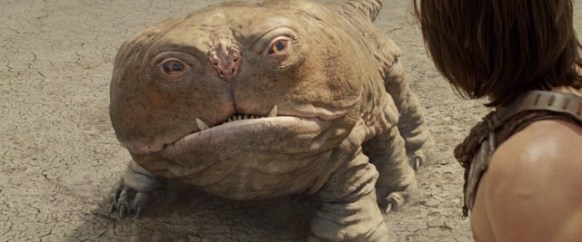
The first thing is how John Carter (the adventurous brainchild of Edgar Rice Burroughs) was able to leap multiple city blocks 40-feet in the air within an hour or so of arriving on Mars.

leaping

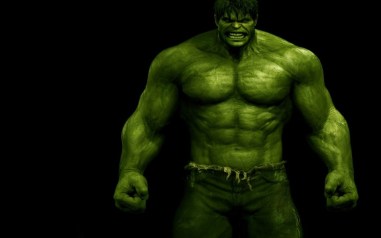
The second thing is how the apparent size of The Hulk changes dramatically depending on what Hulk movie you happen to be watching, and even within any given movie.

hulk

I reckoned that the John Carter issue probably had something to do with the decreased gravity on Mars.  And I really didn’t know what to make of the Hulk issue.  Local variations in the strength of the Earth’s gravitational field maybe?  (OK, I’m reaching here.) But you know what? A bunch of other people have been scratching their heads about these exact same issues!  Weird, huh?

At this site ( Kevin Carr weighs in )an astute chap by the name of Kevin Carr weighed in on John Carter:

“Some have said that John Carter was the first action hero and possibly the first superhero. After all, he certainly acted like one, leaping across the Martian desert. These feats of leg strength began when he first arrives on Mars, learning to walk on a new planet. Once he gets his Mars legs, John Carter is able to jump like the athletic love child of Superman and Michael Jordan. It starts with long bounds, but soon he is able to vertically leap over people, Martians, and even several city blocks about half-way through the film.”

Rice Burroughs himself chalked this up to reduced gravity and thinner air on Mars. For sure the air (mostly CO2) is quite a bit thinner over there, but gravity is still only about 1/3 as strong as what it is on Earth, and I don’t see anyone leaping even one city block here in Calgary, much less anywhere else on Earth, so I remain puzzled.  Maybe John Carter was eating a lot of potatoes.  (see “The Martian”).

Or maybe he just became very buffed by walking his Martian dog.  It’s a big dog.

johns-dog

This brings me to The Hulk aka Bruce Banner.  Like I said, I’m not the only one noodling over this whole business of exactly how big Bruce gets when he needs to save Earth from Aliens or can’t find a pair of matching socks or whatever.

On the site What is the canonical size of The Hulk someone asked this rather long question:

“I’ve noticed that in the recent Hulk movies his size varies from movie to movie. I’ve heard, but don’t know for a fact that the size of the Hulk seemed to change during the 2003 Eric Bana Hulk movie.  In the Ed Norton version he seems to be 2-3 stories tall. But in the more recent Avengers movie I’d say he was more like 2-3 meters. I can see why he is made smaller in this movie, since he was going to go toe-to-toe with Thor.  So, is there a size that is ever mentioned in the comics? Or do the comics leave room for his size to change to fit the situation?

(Just in case you’re wondering, canonical means: “a natural unique representation of an object, or a preferred notation for some object” as well as “authorized, recognized, accepted.”)

Marvel.com says Hulk can be anywhere from 6’6″ to 8’, depending on what color he is and how mad he happens to be.  I thought Hulk only came in one color (green) but apparently not.  And I swear that in one movie I saw, Hulk was 2- or 3-stories tall. Turns out that I just need to go back to film school. Someone with the Twitter handle Krillgar clarified things for all of us, me included:

“He wasn’t 2-3 stories tall. In the scene where he jumps out of the covered bridge at the school, they’re using a low angle looking up from the ground right at his feet. If he was 2 or 3 stories tall, his head would have been scraping the ceiling of the soda plant in Brazil. He was probably around 7’6″ – 8′ tall in The Incredible Hulk.”

So it’s all just camera angles.  I should have thought of that.  But I guess that settles the Hulk issue! And it’s important because there are a lot of Hulk movies.

You know, I was originally going to come at this John Carter/Hulk stuff from the angle of genetics, and whether great athletes are born or are simply the product of intense training/teleportation/10,000 hours, etc. But I’ll leave that for another time when I talk about some of these new sports like Footrug, Aqua Cricket and Gravity Wave Surfing.

Maybe the quickest way to get to the bottom of the John Carter issue once and for all is to just go to Mars myself.  It looks like that will actually be possible in the relatively near future, because in case you didn’t know, Elon Musk and his brilliant, hard-working crew at SpaceX (headquarters conveniently located at 1 Rocket Road, Hawthorne, California) are drinking inhuman amounts of coffee, racing their Teslas, and feverishly laboring to do just that: get Mankind to other planets, Mars being first on their list.

If anyone has gravity figured out, I’ll bet SpaceX does.

I hear they’re hiring, so I’m just going to shoot (!) my resume on down to Hawthorne, CA.

As soon as I finish waxing my gravity wave surfboard.

sky-surfing

Posted in zany, offbeat, somewhat silly humor

Food Mashups and Other Topics

For some reason, I want to spend some time today writing about food mashups.  I also want to mention a new form of matter called spin-liquid.  I haven’t quite figured out how I’m going to segue from food mashups to spin liquid yet, but like Roy McAvoy said in Tin Cup: “When a defining moment comes along you define the moment or the moment defines you.”  So here goes…

Alert readers know that a mashup is “a mixture or fusion of disparate elements”.  So for example you could record together a bunch of different music tracks and wind up with something that sounds like five cats, a parrot and a bunch of empty tin cans loose in a dryer set to “De-wrinkle”.

You could build a house mashup by starting with a dwelling for your pet turtle but then keep adding bits on to the original project as you keep trading up to successively larger pets, as outlined in “Why I Built Fallingwater” by Frank Lloyd Wright.

boogle2

As you can see in the photo below, we have a turtle house grafted on to a duck pen commingled with a rabbit hutch fused to a cat enclosure wedded with a dog kennel.  The nanny goat is trying to convince the boy to become the next occupant but something goes wrong, and instead the goat ends up living in the final structure along with a horse, an elephant (not shown) and a sperm whale (not shown).  Or maybe it was a right whale.  Or maybe I have the right whale but the wrong anecdote.

boogle1

Anyway, enough of that nonsense.  With the holiday season upon us, it’s time for some other nonsense about food mashups.  I forgot about food mashups for a long time after first learning about the Turducken years ago.  As we all know, the Turducken is a deboned chicken stuffed inside a deboned duck tucked inside a deboned turkey.  Sort of like nesting Russian Dolls that you can eat.  According to one article I read, Turducken were popularized by noted chef Paul Prudhomme.  Note that here I am using Turducken to denote both the singular and plural cases.  I could probably have used Turduckens for the plural case, now that you mention it.

I was astounded (well maybe not that astounded) to find out that this notion of an infinite (well maybe not infinite, but pretty darned long) series of cooked birds nestled inside progressively larger cooked birds extends back through time all the way to the early Romans who, by the way, are also credited with the invention of Tums.

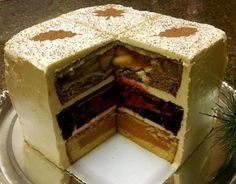
So anyway my point is that of late, I hadn’t been spending a lot of time thinking about food mashups in general or Turducki in particular.  (Or is it Turducken?  Turduckens? I’m still not clear on this point.)  Then I heard about Piecakens, courtesy of noted Toronto chef, Arden Longmuir.

Outwardly, the typical piecaken looks like your basic frosted cake, but if you take the trouble to do a terahertz scan of the thing, you will discover that there are one or more pies sequestered inside the “cake”.  If you don`t have a terahertz scanner you can just cut it open and reach the same conclusion.(A terahertz scanner is that thing at the airport that can show people what you look like in the nude.)

cake

Piecakens usually offer up between 40,000 and 60,000 calories per slice, enough to satisfy the average fully-grown Kraken for several days.  You`ll recall that Krakens are giant sea monsters said to inhabit the coastal waters of Norway and Greenland.

kraken

People think that piecakens are a relatively new phenomenon, but like the Turducken, the concept can actually be traced far back in time, zooming past the Romans and going all the way to the early Jurassic Era.     (I may be lying about this last bit, as there were no terahertz scanners in the Jurassic Era.)

Actually, a coffee table book author by the name of Charles Phoenix says that in 2007 he invented a type of piecaken called a cherpumple, which is a mashup of cherry, apple and pumpkin pies.  He’s not sure if he’s the first person to have had the notion to stick a pie inside a cake, but he reckons he is the first person to have made Internet headlines by doing so.  But regardless of their origin, foods like the piecaken and its evil twin sister the cherpumple are everywhere these days.  The piecaken even won a spot on Kelly and Michael just after Thanksgiving 2015; Kelly wisely chewed on a brochure picturing a piecaken, sparing herself 73 extra hours on the treadmill.

But it turns out that for sheer ingenuity, the Inuit of Greenland and Canada are eating the collective lunches of Kelly Ripa, the ancient Romans and all the denizens of the early Jurassic Era, terahertz scanners or no.  But almost no one is eating the lunches of the Inuit when they are serving a traditional winter food called Kiviak.

Kiviak is made by gutting a seal and stuffing the blubber-lined carcass with hundreds of Little Auks (Alle alle), which are tiny starling-sized seabirds (also known as Dovekies).  I swear on Dave Barry`s driver`s license that I am not making any of this up.

dovekies

The first thing you are probably asking yourself is why don`t the Inuit use Great Auks?  Well Great Auks are too big for one, and secondly there aren’t any Great Auks left because they were all eaten by the Kraken.  (Or is it the Krakens?  I’m still not clear on this point.)

Anyway, the auk-stuffed carcass is sewn up and left to ferment under a pile of rocks for up to 18 months.  Below we are seeing an actual seal carcass, looking a lot like the pod of some kind of large Alien insect, being slit open in readiness for lunch.  I swear on Sigourney Weaver`s driver`s license that I am not making up so much as a single syllable of any of this, either.

kiviak

According to foodie Marissa Brassfield, the seal’s fat acts as a tenderizer and preservative; this enables people to eat the birds raw, bones and all.  Apparently it is even common practice to bite off the tiny bird’s heads and then suck out the juices, which are chock-full of nutrients.  Kiviak apparently tastes like some kind of ripe cheese and since it is quite pungent, it is eaten outdoors, typically about 500 miles offshore.  Even Krakens won’t touch it with a hundred-foot tentacle.

Kiviak is considered a special treat to celebrate weddings, birthdays, Christmas and other special occasions such as the discovery of spin-liquid, which was announced late this year by physics professor Takashi Imai at McMaster University in Hamilton, Ontario, located about 2900 kM southwest of Nuuk, the capital city of Greenland.

Spin-liquid, existing in theory for more than forty years, was recently confirmed in crystalline matter chilled to -272 °C and subjected to magnetic fields 60,000 times stronger than Earth`s.  Under these conditions the electrons refuse to line up in opposite-spin pairs, and remain in an unresolved, or “liquid” state.  I don`t know about you, but if someone tried to chill me to -272 °C and subject me to a ferocious magnetic field I would probably be a little ornery too.

Currently there are no practical applications for this new material, but I`m going to give it some thought as soon as I finish the last –buuurp-helping of this new food mashup I just dreamed up: strands of red licorice threaded through corn dogs baked in banana peels and garnished with Worcestershire sauce.

Just remember; you read it here first.