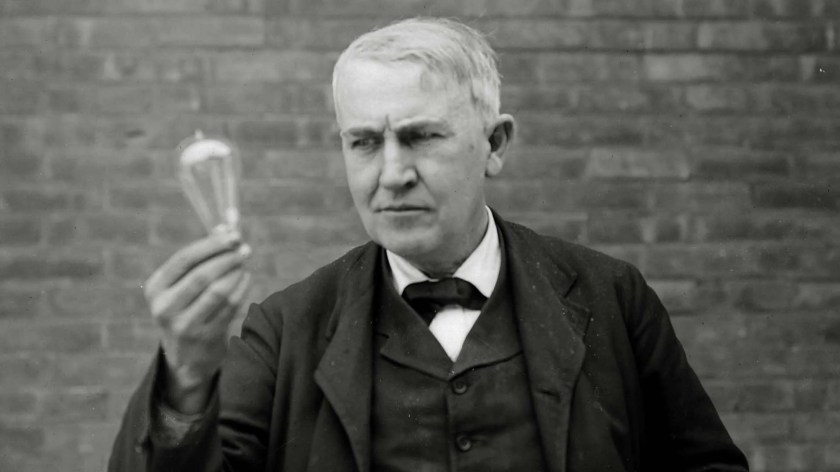
A couple of months ago I noticed that two of the four LED bulbs in one of the light fixtures hanging over the island in our kitchen had gone dim (but not out). Two more bulbs in the fixture hanging in our foyer also went dim (but not out). Note that foyer does not rhyme with lawyer. In true Canadian fashion, foyer is pronounced “foy-eh”. So, it rhymes with sashay or whey or “go away”. Just saying.
One of the attributes of lightbulbs, LED or not, is color temperature or hue (warm, cool, etc). The unit of measurement for hue is the Kelvin. The Scottish fellow who invented the Kelvin scale for temperature measurement was actually named William Thomson. He was a mathematician, physicist, engineer and a pretty righteous eel-fisherman who lived near the river Kelvin. Eventually he was ennobled as Lord Kelvin, in part for his contribution to developing the first and second laws of thermodynamics but also for his contribution to the grand unified theory of dance competition medals and his recipe for sauteed eel.

I bring color temperature up only because my dim bulbs (which were made by an outfit called SATCO) were rated at 3000K (whitish). I bought a few 2700K (somewhat yellowish) bulbs to vet as possible replacements for all the remaining 3000K bulbs but they didn’t pass muster: too yellow. I ordered more 3000K bulbs from SATCO but a couple of them also went dim after a short while. Coincidence? I think not. So. I started poking around.
Back about 20 years ago, a company named Lights of America was sued for false advertising and had to fork over millions of dollars to disgruntled customers whose bulbs were failing at an alarming rate and were definitely not outperforming incandescent bulbs as claimed. But there have been no LED-related lawsuits since then.
So. I started poking around again, by actually reading the disclaimers on the LED bulb packaging. Most manufacturers consistently quote a maximum lifetime of 13 or so years if the LEDs are lit for 3 hours/day. Lit for 9 or 10 hours/day, the bulbs would probably last 3 to 5 years and most manufacturers warrant their bulbs to last that long. That seemed reasonable. But I still didn’t know why my bulbs weren’t lasting that long.
In that ancient, iconic movie, Sleepless in Seattle, Tom Hanks has this to say to his son, Jonah, regarding his new girlfriend, Victoria (Barbara Garrick in case you were wondering): “Jonah, listen to me. You don’t know Victoria. I hardly know her myself. She is a big mystery to me. She tosses her hair a lot. Why does she do this? I have no idea. Is it a twitch? Does she need a haircut? Should she use a barrette to keep her hair out of her face? These are things I’m willing to get to the bottom of.”

Just like Tom, there are things that I, too, am willing to get to the bottom of. Not that I’m anal or anything. So, I poked around yet again, to understand these bulbs better.
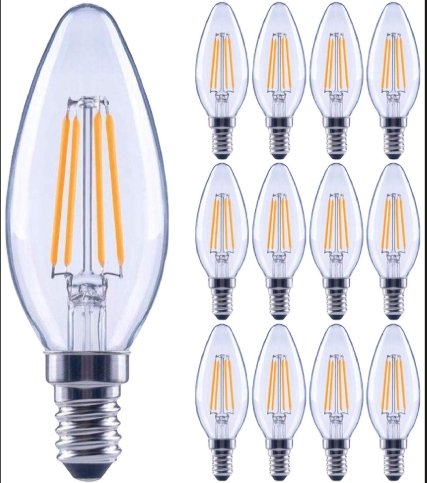
LED bulbs get hot: just not as hot as incandescent bulbs. Fifty to seventy percent of the electricity fed to the yellow LED strips/”filaments” winds up as heat (compared to more than 90 percent for incandescent bulbs). Here is an example of the LED candlelabra-type lightbulbs that inhabit the fixtures hanging above the island in my kitchen. Correction: in my wife’s kitchen which I am occasionally allowed to occupy when I pass the “Why are you even in this kitchen right now, anyway?” test.
Ironically, though they’re not that efficient, incandescent bulbs can last for decades, maybe centuries even. Recently, an incandescent bulb was found still burning in the basement of an Egyptian pyramid. It (the bulb) was estimated to be at least 4000 years old. Below is a tablet found next to the bulb, warranting the bulbs lifetime for 6000 years, give or take. Time will tell.

Don’t believe everything you read though, because fake news is everywhere. Just ask Kevin O’Leary
Anyway, hieroglyphics aside, along with the heat generated by the LEDs, additional heat emanates from the tiny chips that lurk down in the base of the bulbs; these chips mind their own business, busily converting 120V AC to a few volts DC. Bless their little hearts.
Here’s a view of one such chip, minding its own business and hoping it’s not going to be extracted. It’s easy to see how that thing can fry itself if it gets too hot, as the heat can get trapped in the base.
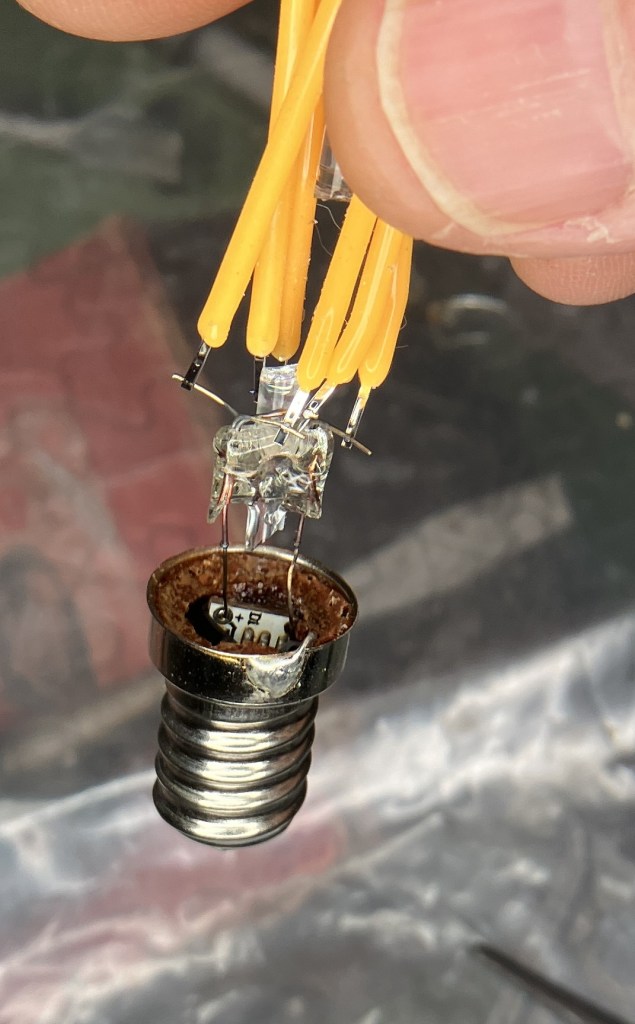
Sorry. I couldn’t resist extracting that chip. Enquiring minds want to know.
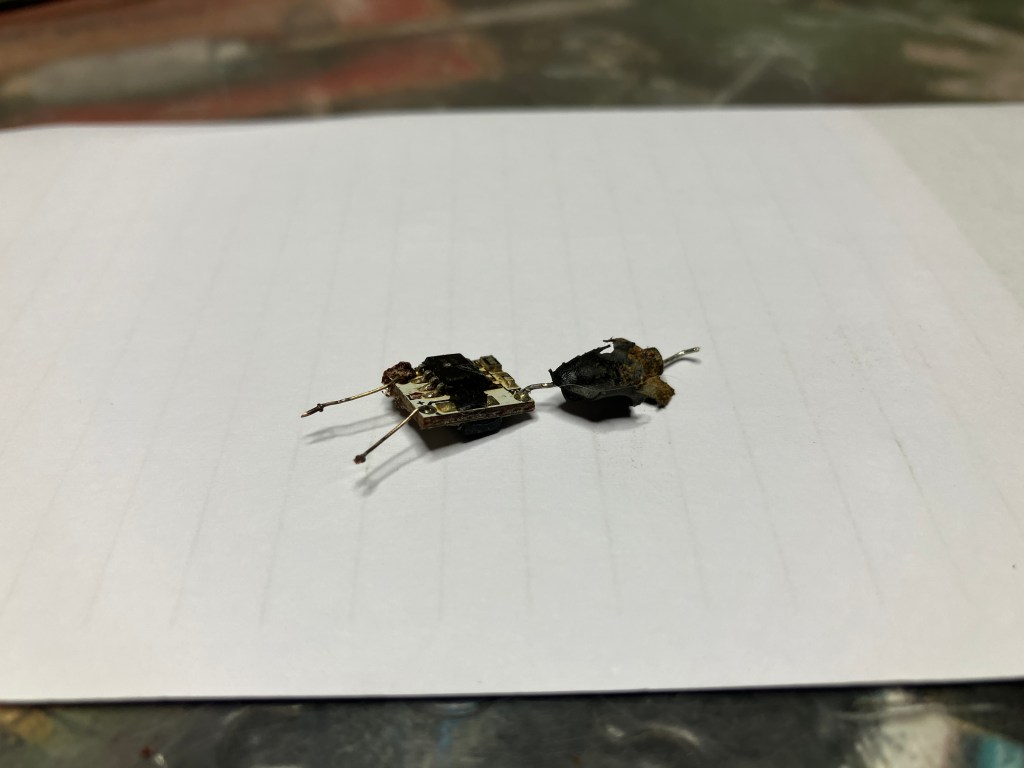
To recap, I initially went off half-cocked about this whole business. LED bulbs weren’t that well-made or reliable two decades ago. The manufacturers now know a thing or two about a thing or two and today, for the most part, LED failure isn’t due to shoddy manufacturing. I still wouldn’t buy bulbs that are ridiculously inexpensive though. Buy bulbs that have a manufacturer’s warranty.
If your LED bulbs fail, it’s likely the fault of the fixture. You can’t take just any LED bulb and stick it into just any fixture. Some fixtures trap heat more than others and this can result in LED failure inside of a year. Trust me on this. Buy bulbs that are “enclosure-rated”. They’re built to take the heat.
Sermon ended but I must say one more thing. I don’t want to leave alert readers dangling.
Full disclosure: this post was intended to be about a professional strong man who believes he has become the first person in the world to pull a car with his genitalia-while on fire. I just couldn’t figure out what actually was combusting: was it the car, the man’s Johnson, or some other body part?
Dangling modifiers, such as “-while on fire” are the bane of responsible writers. Clarity is everything.



Another amazing post. Wish I had your ability to put together cleaver ideas.
Ant way, I just checked on the status of the pending press release with the NSX contract partner. I am still getting it should be any day now. Personally I can’t wait!
Best to you,
John
John Osth CEO, NanoSomiX, Inc. josth@nanosomix.com 949-922-8646
>
LikeLike