This was originally posted July 2, 2015. At that time it was a little overdue because it took me longer than anticipated to get those pesky RFID chips that I mentioned last post out of my distal colon. But that’s all behind (!) me now and it’s time to move on and talk about moving in general and treadmill desks in particular.
A few months ago I was sitting at my office desk when I was suddenly seized by an uncontrollable urge to start standing at my desk all day instead of sitting at it all day. This wasn’t a random obsession like some other random obsessions I’ve had but was actually driven by my having just read a book by Dr. James Levine MD PhD entitled: “Get Up! Why your chair is killing you and what you can do about it.”

To be clear, Dr. Levine has nothing against chairs. He is an endocrinologist and an obesity researcher as well as the Director of the Mayo Clinic/Arizona State University Obesity Solutions Initiative. One of the key messages in Dr. Levine’s book is basically that humans weren’t meant to sit down all day, and regular workouts can’t compensate for the amount of time we spend in our chairs. He is also noted for coining the phrase “Stuffed Burrowing Owls are the New Furbys”.

Actually, I’m lying. Levine coined the phrase: “Sitting is the New Smoking.”
Anyway, the rationale for why sitting is bad for you revolves around explaining why standing is good for you. When you are standing, the large muscles in your legs are more active (unless you are duct-taped upright to a tree or lamp-post) and will absorb lots of glucose (sugar) from your blood. Standing also increases your basal metabolic rate. Conversely, when you are sitting around all the time, your basal metabolic rate is lower, it’s more difficult for your body to clear glucose from your blood and your pancreas has to produce more insulin to compensate. Over time this leads to Type II diabetes.
The pancreas doesn’t get a lot of air time because, to be honest, as far as organs go, it’s pretty unfortunate-looking (Exhibit A). It’s also quite a shy organ and doesn’t get out much as it’s closeted between the stomach and the spine and surrounded by the liver, the spleen and the small intestine.

Burning glucose simply by standing is called NEAT or Non Exercise Activity Thermogenesis. Not that it matters, but NEAT can easily be rearranged to ETNA, meaning maybe your insurance premium will go down next year if you stand all day but don’t bet on it. Alert readers will note that I shamelessly borrowed here from Dave Barry’s lexicon of literary devices which include rearranging a seemingly normal acronym to make a funnier, or at least a more interesting one.
Anyway, more NEAT means your pancreas doesn’t have to make as much insulin, and the insulin you do make will work better. This will reduce your risk of diabetes but the jury is still out regarding the effect on other degenerative conditions such as birdwatching and reselling stuff you bought at garage sales on Facebook Marketplace.
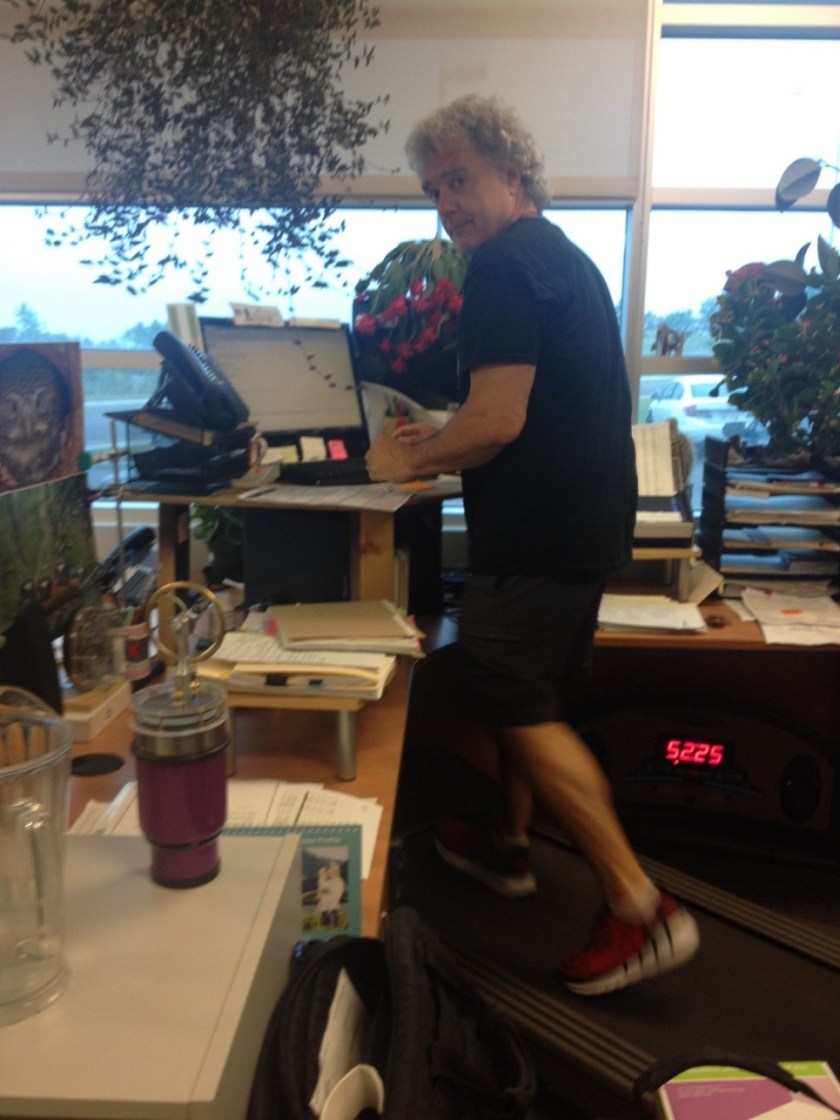
Long story short, standing at least intermittently throughout the day is much better for you than sitting for 8 hours straight. However, the shine eventually wore off just standing there, immobile, day after day. Fortunately, I was seized by yet another urge which involved converting my desk into a treadmill desk. A treadmill desk is exactly like an ordinary desk, except it’s higher and has a treadmill in front of it. Levine says walking slowly on a treadmill is a great way to increase NEAT.
Oddly enough though, with all that standing and slow walking, I found myself constantly fighting the urge to go outside and nibble grass for some reason.

Levine is widely credited as the inventor of treadmill desks but that distinction likely should belong to Nathan Edelson, who patented a design for a portable desk intended to be used with a treadmill back in 1993. Dr. Levine does get credit though, for helping to popularize working while walking on a treadmill via his Get UP! book but also via his other book: If These Boots Are Good Enough For Nancy, They’re Good Enough For You.

I bought a used treadmill, removed the handrails, slid it under my desk, built a platform for my phone, computer, stuffed Burrowing Owl, etc. and off I went. In his book, Dr. Levine cautions the neophyte treadmilling worker, saying: “There’s a tendency to want to jump on the treadmill and walk for hours and hours a day. Don’t do that. Certainly, at the absolute maximum, do half-hour on, half an hour off, for two to three hours a day.” He also suggests a top speed of 0.5 to1.5 mph.
So naturally, being the possessor of a Y chromosome (trillions, actually), I began walking for 8 hours straight, on Day One, which happened to be a Monday. By the following Thursday afternoon I was happily clocking along at 2.5 mph and by Friday afternoon, I had acute pain and tenderness in my lateral left lower extremity, six inches above the ankle. I could barely walk. I swear on my podiatrists medical license that I am not making this up.
But several weeks later, after I ditched the crutches, I was back at treadmilling and settled into a steady 1.5 mph, still fighting the urge to nibble grass and stopping only to go to the bathroom. Typing and mousing took a while to master but I got there.
Fast forward a few months. My FitBit kept flashing the “Full” symbol but I’m a few pounds lighter and my belt is several notches tighter. Tracy, one of the two people I share my office with, goes around with a hunted look in her eyes most of the time and has taken to muttering and wearing earplugs. Martin, my other office mate, is pretty blasé about the whole thing. He thinks that the electrically-grounded, tinfoil lined hat I’m wearing (to prevent static buildup) is a bit weird but otherwise he’s cool with the incessant low-grade droning of the treadmill.

Levine was certainly right about the thermogenesis bit. I had to install a couple of fans trained on my head and torso, once summer arrived. I haven’t gotten any bloodwork to check on my metabolic parameters since I started treadmilling but one of these days I will. I just have to amble on over to the nearest Alberta Health Services lab. It’s 14.3 miles one way but somehow I think I’m up to the walk.
 The Department of Lateral Thinking
You must be logged in to post a comment.