The other day I was leafing through the latest edition of Plate Tectonics magazine when I came across an interesting article.
Alert readers know that Plate Tectonics is not about dinnerware.
Plate Tectonics is the branch of science that concerns “the structure of the Earth’s crust and many associated phenomena resulting from the interaction of rigid lithospheric plates which move slowly over the underlying mantle, minding their own business most of the time, voting in favor of fiscal responsibility and fewer pronouns, when need arises, and occasionally crashing into each other, causing earthquakes, eruption of deep sea hydrothermal vents and last but not least, toilet paper shortages.”
Actually, I’m lying. First of all, there is no “Plate Tectonics” magazine. If there was, no one would read it. There’s a lot of stuff going on down below the Earth’s surface but most of it is happening extremely slowly. Reading a magazine devoted to Plate Tectonics would be like reading a magazine devoted to what you can learn by watching your toenails grow.
Things have been pretty busy here in The Department Of Teetering On The Edge Of Sanity For The Last Three Months Whilst Preparing A Complicated Biochem Talk That Took Every Spare Minute Of My Free Time And Practically Drove Me Bonkers.
(Jeanette, my better half, wasn’t all that stoked about it either.)
I finished the talk yesterday. Thank Heaven. Between the greeting card montages and the Biochem talk, you now realize why I haven’t been posting consistently these last few months. I hereby offer a proactive apology for this longish post.
Scientific inquiry can be hazardous. According to noted ancient sheep-herder and philosopher, Aristotle: “There is no great genius without a touch of madness.”
Take Ludwig Boltzmann for example. Boltzmann developed the dense forest of equations that founded the branch of Physics known as Statistical Mechanics. Here are a few of the trees from that forest:
These are very similar to the equations used by the IRS and the CRA to calculate the probability that the CRA, or worse yet the IRS, will audit you this year
The reason I know about Boltzmann’s fate is because a friend of mine whom I’ll call “Bob”, being the helpful soul that he is, sent me a meme a couple of days before I finished the Biochem talk. Bob knew that my foray into the depths of Biochemistry was driving me bat-shit crazy, not to put too fine a point on it.
This is part of the meme:
Boltzmann is one of these two intense-looking fellows. The probability that Boltzmann is the fellow on the right is exactly 50%. Boltzmann died in 1906, at the age of 62.
The other guy in the photo is Rudolf Clausius who recasted the First and Second Laws of Thermodynamics, building on Boltzmann’s work. He also invented the game of Clue AND the Clausius Clapeyron equation, which we all knew and loved back in our High School Chemistry days. Clausius died in 1888 after a lingering illness. Coincidentally, the probability that he is the fellow on the left photo is also exactly 50%.
Statistics is full of surprises.
Surely not everybody loved the Clausius Clapeyron equation-along with Kung-Fu fighting
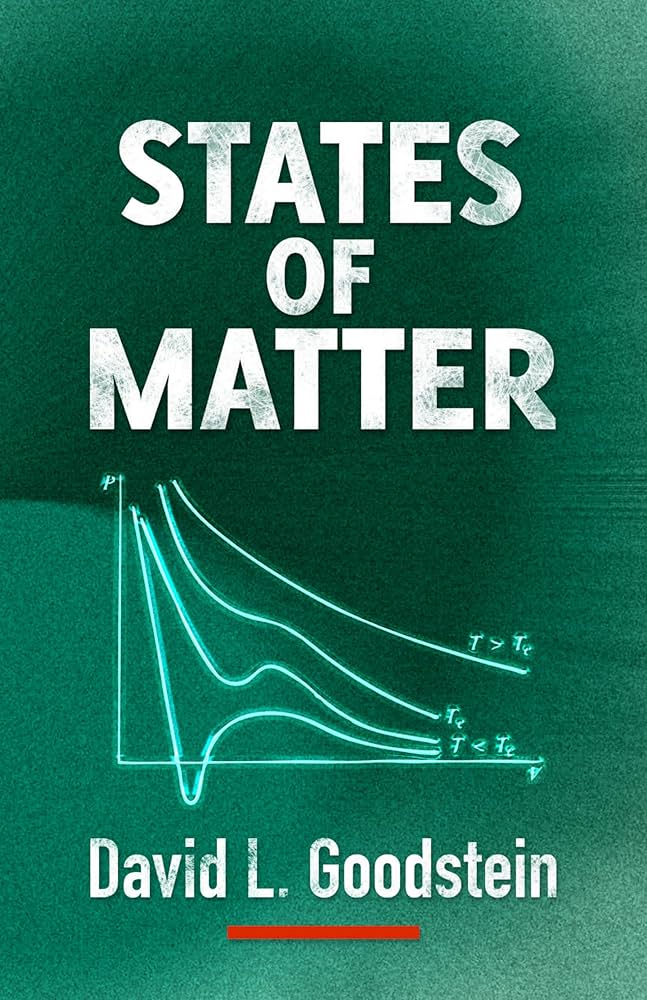
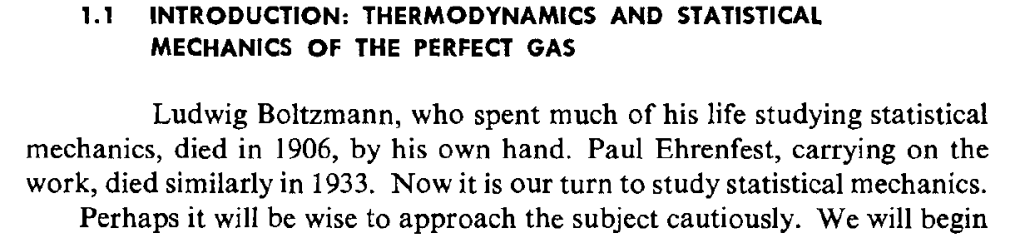
The other part of the meme was lifted out of the introduction section in the book: States of Matter written by former Physics/Applied Physics Professor David Goodstein. Dr. Goodstein passed away peacefully in April 2024 at the age of 85. He earned many accolades and wrote many papers: he was well-respected and well-loved.
Here’s the book and the introduction:
Per the last sentence, I forgot to mention that Goodstein also had a penchant for understatement.
So here we have four brilliant scientists who were deep in the weeds of fundamental physics. Two died peacefully and the other two took their own lives. Looks like Aristotle’s assessment was on target, or as the Greeks would say: “στο στόχο”.
(I forgot to mention that in addition to card montages and Biochem talks, I’ve been learning Greek for the last year or so.)
Note: Boltzmann and Ehrenfest were suffering from Bipolar Affective Disorder (BPA). BPA engenders wildly creative out-of-the-box thinking necessary for breaking new ground in any scientific endeavor but brings with it bouts of crippling depression. BPA is a devastating illness and I am in no way belittling people who suffer from it. My point is that unrelenting attempts to understand and codify the Universe can take their toll. There are things we just aren’t meant to understand, no matter how hard we try.
Moving right along here, and to lighten things up, I need to point out that even though Physics has an undeserved reputation as being too inaccessible and arcane, it’s still relevant for Earthlings.
For example, Statistical Mechanics, a branch of Physics, can deal with difficult questions such as, “What is the probability that you will bump into your wife in the kitchen when she doesn’t want you to be there?”
Then there’s this Physics/Cosmology theory called Inflation which posits that the Universe, starting from an infinitesimally-small point, expanded in diameter by a factor of 1026 and in volume by a factor of 1078. Supposedly it only took 10-32 seconds.
This is very relevant to daily living because 10-32 seconds is roughly the time it takes for an initial estimate of the cost of a kitchen reno to cosmically inflate to what you will ultimately be paying. (It’s also comparable to the time it takes for newly-elected Calgary City Councillors to vote themselves large raises. Not that I’m bitter.)
This leaves us with Entropy, the Second Law of Thermodynamics and String Theory. The Second Law basically says that, left to itself, the mess on your desktop will spontaneously go from bad to worse. (Increased Entropy.)
String Theory postulates that many elementary particles consist of tiny vibrating strings that are even smaller than the screws that hold the arms on to your glasses: or maybe smaller than the little filaments inside the Flintstones-era incandescent Christmas tree light bulb strings.
Here’s a real-world example of Entropy and String Theory:
It’s early in January. You finally get around to packing up your old pre-lit Christmas tree. Every light bulb works fine. Fast-forward to December. You take the three tree segments out of the box and plug in the base segment. It lights up just dandy. Then you socket the middle segment to the base and this is what you get:
Then you socket the apex segment into the middle segment and again, this is what you get:
Now you have a small black hole, spanning two tree segments, lurking right there in your living room !!
Clearly, things spontaneously went from bad to worse while the light filaments were minding their own business inside their box for eleven months. Damn that Second Law!
My best guess is that the tiny elementary particles inside the bulb filaments actually ARE vibrating strings. They vibrated so much that the the filaments broke apart while nobody was watching.
Being an inveterate tinker-arounder with electricity and electronics since the age of 12 and also possessing medical expertise – or at least having done Surgical Rotations in Clerkship and Internship – you set to work mapping the wiring diagram and discover that there are two dead fifty-bulb loops inside the black hole.
Clearly, you have an Electrosurgical Emergency on your hands.
You carefully unwrap the dead loops from the tree but don’t excise them. Yet. Now you’re faced with the artificial Christmas tree version of two infarcted loops of small intestine right in your living room.
You prepare the surgical field, being careful to also mark the excision sites with colored tape. After all, nobody wants to put a new hip joint in somebody’s right hip when the left hip is the one with the problem.
Now you excise the offending loops, find the offending bulbs, replace them, temporarily wire the loops back into the tree’s nervous system with clip leads, lay the loop(s) on the sofa for testing, remove the clip leads, cauterize the splices then re-wrap the loops back amongst the branches.
This morning I was fulfilling my duties as the Director of the Arbour Lake Department of Bernese Mountain Dogs, minding my own business and taking my Berner, Sarge, for an emptying, when I encountered someone who had a container hanging on a strap around their neck. The container featured air vents and a clear plastic half-dome windshield. I thought it might have been a re-entry pod or something space-related. From a distance I could see a passenger moving inside and I thought maybe it was a ferret or possibly a stoat. Turns out it was neither.
I’m pretty sure that you don’t care, but I’m about three weeks overdue in writing this post. Instead of wasting time thinking up an intro line such as: “Here in the Department of Thinking About How to Defend Yourself From An Attacker Armed With A Banana…” or “Here in the the Department Of Never Knowing When It’s A Good Time To Switch Back To Summer Tires Because It’s Been Known To Snow Every Day Of The Year Here In Alberta…”, I’m just going to dive in.
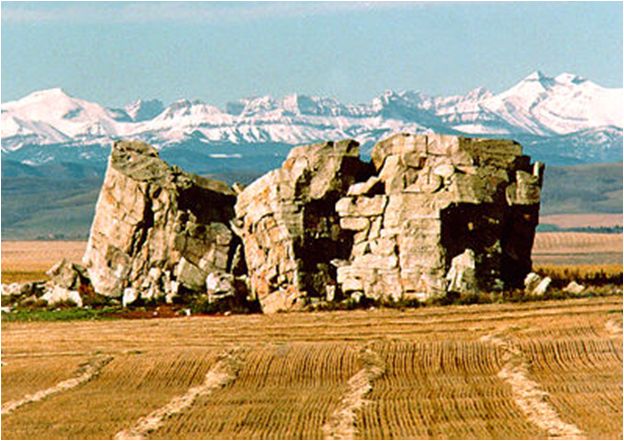
I went with my daughter last week, to a pretty excellent toy store called Monkey Mountain, conveniently located in the town of Okotoks, Alberta. One of the other things that contribute to the general excellentness of Okotoks is the imaginatively-named Big Rock, a glacial erratic boulder sitting in a field west of Okotoks. The Big Rock is conveniently located near the foothills of the Canadian Rockies.
Big Rock, sitting in a field wishing that it had a cooler name but at the same time pretty stoked that it has such a great view of the Rocky Mountain foothills (in background)
But that’s not my point. My point is that my daughter and I both got a little giddy marveling at the vast cornucopia of toys in that store, including the usual suspects such as Lego, Playmobil, cat-sized shark oufits (after all, who doesn’t want to dress their cat in a shark outfit?), cont…
…Roombas (after all, who doesn’t want to plop their cat on a Roomba after it (the cat) has been clothed in a shark outfit?), cont…
Intrepid cat accompanied by its friend, Nestor
…miniature particle accelerator kits, dredging equipment, fiendishly-complex, dinky DIY dollhouse room kits and so forth.
Shark-themed cat outfits aside, it was the Calico Critters that really caught my eye and accordingly, I felt like I should bring alert readers up to speed. If you like fiendishly-dinky DIY dollhouse room kits you will love the Calico Critters.
Note that the Calico Critters is not a new type of infectious disease. Or a country music band.
The Department of Stringing Random Topics Together in One Post has its work cut out for it today because it has to weave the following topics into a coherent narrative: ways to screw up the making of a pot of drip coffee, alligator attacks, Hail Mary football plays, the world record for human female tongue circumference and last but not least, Mountain Chicken Frogs.
Before this gets underway, I have to point out that I shamelessly took this post’s feature image of the guy with the snazzy oven mitts from a blog called Rebecca Grace Quilting.
I hereby admit that I also shamelessly lifted a picture from that blog, of the author/accomplished seamstress, Rebecca Grace. Rebecca seems like a very friendly person if you ask me:
At this point you’re probably wondering, “Just what the heck kind of an opening paragraph is this, even?”
Alert readers of this blog know that here in the Department of Not Having Enough To Do, we concocted a large spreadsheet which codified the relatively unexplored universe of State Attributes aka State Symbols and tried to suss out what the Attributes might tell us about each State.
Based on what I and a friend of mine learned when we staggered around Eastern Idaho for a week this past Fall, we realized that we had to talk about the State Attribute situation in Idaho. We had absolutely no idea what was going on out there.
Don’t get me wrong. I have nothing against Idaho. Napoleon Dynamite, the movie, was set in Idaho. Idaho and I were neighbors for three years when I lived in Ontario, Oregon, about a mile from the Snake River/Idaho border. I’ve done a lot of back country exploring/camping in Idaho. One of my sons will soon wed an Idahoan.
So basically, Idaho and I are on good terms. That said, when it comes to State Attributes, Idaho is a bit of a fixer-upper, in need of a bit of sprucing-up
A couple of weeks ago, my friend Bob started talking about the Seinfeld TV show which initially aired back in the early nineties. Eventually I had to ‘fess up and sheepishly disclose to him that I had only seen one episode of Seinfeld when it was current-the one in which Kramer decided to live in his shower.
When “Bob” regained consciousness, after passing out from sheer incredulity, he strongly opined that I absolutely had to watch all 169 episodes, as they were bordering on comedic genius. Not to mention running jokes.
Before I get going on The Doughnut Problem I need to backtrack a bit and comment on Attribute Creep, discussed in Part I. It seems to me that the general tendency toward adding more and more State Attributes is a 21st Century thing. I blame the Y2K scare.
My theory, which could be invalidated at any time in the face of new information, is this; people were so relieved that Society didn’t collapse on January 1, 2000 that they loosened their ties and got serious about commemorating stuff. Prior to this tie-loosening there was no point commemorating anything because a lot of people were pretty certain that we were all going to be catapulted back into the Stone Age.
Anyway, here we are almost 23 years later and things haven’t gone in the shitter. Yet. We should all remember the State Motto of South Carolina if we don’t already have it memorized: While I Breathe I Hope-Prepared in Mind and Resources.
All that aside, before we can talk about The Doughnut Problem we should probably discuss the State Dessert Problem in general and Massachusetts in particular. This requires another Venn diagram. Don’t say I didn’t warn you.

















 The Department of Lateral Thinking
You must be logged in to post a comment.