
Things have been pretty busy here in The Department Of Teetering On The Edge Of Sanity For The Last Three Months Whilst Preparing A Complicated Biochem Talk That Took Every Spare Minute Of My Free Time And Practically Drove Me Bonkers.
(Jeanette, my better half, wasn’t all that stoked about it either.)
I finished the talk yesterday. Thank Heaven. Between the greeting card montages and the Biochem talk, you now realize why I haven’t been posting consistently these last few months. I hereby offer a proactive apology for this longish post.
Scientific inquiry can be hazardous. According to noted ancient sheep-herder and philosopher, Aristotle: “There is no great genius without a touch of madness.”
Take Ludwig Boltzmann for example. Boltzmann developed the dense forest of equations that founded the branch of Physics known as Statistical Mechanics. Here are a few of the trees from that forest:

The reason I know about Boltzmann’s fate is because a friend of mine whom I’ll call “Bob”, being the helpful soul that he is, sent me a meme a couple of days before I finished the Biochem talk. Bob knew that my foray into the depths of Biochemistry was driving me bat-shit crazy, not to put too fine a point on it.
This is part of the meme:

Boltzmann is one of these two intense-looking fellows. The probability that Boltzmann is the fellow on the right is exactly 50%. Boltzmann died in 1906, at the age of 62.
The other guy in the photo is Rudolf Clausius who recasted the First and Second Laws of Thermodynamics, building on Boltzmann’s work. He also invented the game of Clue AND the Clausius Clapeyron equation, which we all knew and loved back in our High School Chemistry days. Clausius died in 1888 after a lingering illness. Coincidentally, the probability that he is the fellow on the left photo is also exactly 50%.
Statistics is full of surprises.

The other part of the meme was lifted out of the introduction section in the book: States of Matter written by former Physics/Applied Physics Professor David Goodstein. Dr. Goodstein passed away peacefully in April 2024 at the age of 85. He earned many accolades and wrote many papers: he was well-respected and well-loved.
Here’s the book and the introduction:
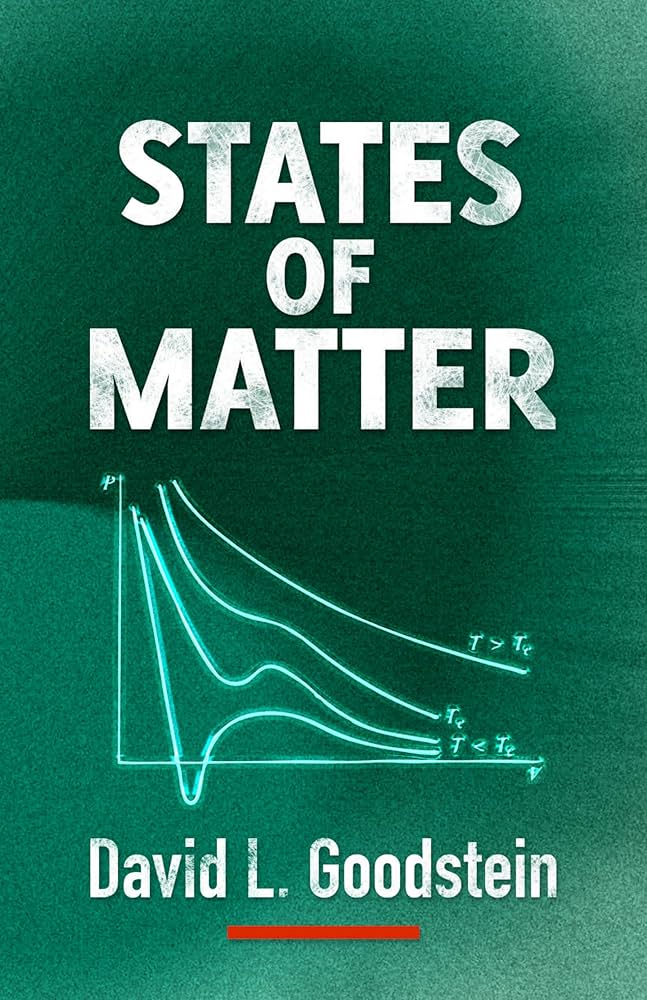
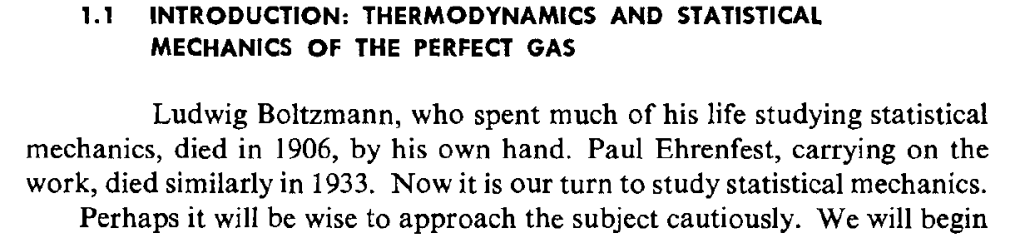
Per the last sentence, I forgot to mention that Goodstein also had a penchant for understatement.
So here we have four brilliant scientists who were deep in the weeds of fundamental physics. Two died peacefully and the other two took their own lives. Looks like Aristotle’s assessment was on target, or as the Greeks would say: “στο στόχο”.
(I forgot to mention that in addition to card montages and Biochem talks, I’ve been learning Greek for the last year or so.)
Note: Boltzmann and Ehrenfest were suffering from Bipolar Affective Disorder (BPA). BPA engenders wildly creative out-of-the-box thinking necessary for breaking new ground in any scientific endeavor but brings with it bouts of crippling depression. BPA is a devastating illness and I am in no way belittling people who suffer from it. My point is that unrelenting attempts to understand and codify the Universe can take their toll. There are things we just aren’t meant to understand, no matter how hard we try.
Moving right along here, and to lighten things up, I need to point out that even though Physics has an undeserved reputation as being too inaccessible and arcane, it’s still relevant for Earthlings.
For example, Statistical Mechanics, a branch of Physics, can deal with difficult questions such as, “What is the probability that you will bump into your wife in the kitchen when she doesn’t want you to be there?”
Then there’s this Physics/Cosmology theory called Inflation which posits that the Universe, starting from an infinitesimally-small point, expanded in diameter by a factor of 1026 and in volume by a factor of 1078. Supposedly it only took 10-32 seconds.
This is very relevant to daily living because 10-32 seconds is roughly the time it takes for an initial estimate of the cost of a kitchen reno to cosmically inflate to what you will ultimately be paying. (It’s also comparable to the time it takes for newly-elected Calgary City Councillors to vote themselves large raises. Not that I’m bitter.)
This leaves us with Entropy, the Second Law of Thermodynamics and String Theory. The Second Law basically says that, left to itself, the mess on your desktop will spontaneously go from bad to worse. (Increased Entropy.)
String Theory postulates that many elementary particles consist of tiny vibrating strings that are even smaller than the screws that hold the arms on to your glasses: or maybe smaller than the little filaments inside the Flintstones-era incandescent Christmas tree light bulb strings.
Here’s a real-world example of Entropy and String Theory:
It’s early in January. You finally get around to packing up your old pre-lit Christmas tree. Every light bulb works fine. Fast-forward to December. You take the three tree segments out of the box and plug in the base segment. It lights up just dandy. Then you socket the middle segment to the base and this is what you get:

Then you socket the apex segment into the middle segment and again, this is what you get:
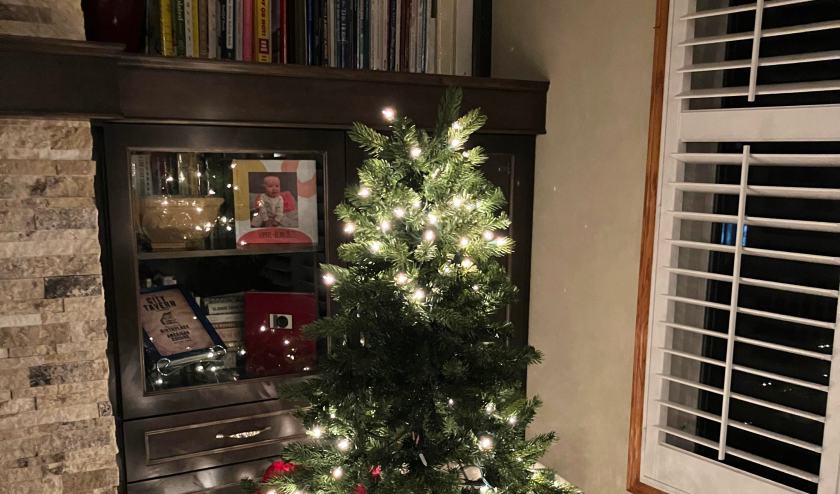
Now you have a small black hole, spanning two tree segments, lurking right there in your living room !!
Clearly, things spontaneously went from bad to worse while the light filaments were minding their own business inside their box for eleven months. Damn that Second Law!
My best guess is that the tiny elementary particles inside the bulb filaments actually ARE vibrating strings. They vibrated so much that the the filaments broke apart while nobody was watching.
Being an inveterate tinker-arounder with electricity and electronics since the age of 12 and also possessing medical expertise – or at least having done Surgical Rotations in Clerkship and Internship – you set to work mapping the wiring diagram and discover that there are two dead fifty-bulb loops inside the black hole.
Clearly, you have an Electrosurgical Emergency on your hands.
You carefully unwrap the dead loops from the tree but don’t excise them. Yet. Now you’re faced with the artificial Christmas tree version of two infarcted loops of small intestine right in your living room.
You prepare the surgical field, being careful to also mark the excision sites with colored tape. After all, nobody wants to put a new hip joint in somebody’s right hip when the left hip is the one with the problem.


Now you excise the offending loops, find the offending bulbs, replace them, temporarily wire the loops back into the tree’s nervous system with clip leads, lay the loop(s) on the sofa for testing, remove the clip leads, cauterize the splices then re-wrap the loops back amongst the branches.
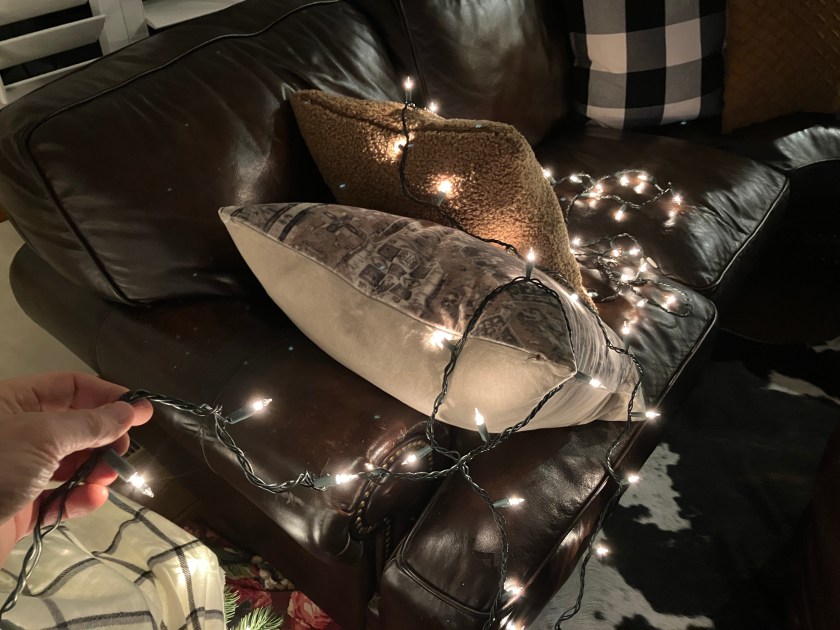
Voila!

See.
Physics isn’t so bad after all.
 The Department of Lateral Thinking
You must be logged in to post a comment.