What follows is the Lateral Thinking Department inaugural post, written in June of 2015. I felt like I should dust it off and spruce it up a bit.
One day in June 2015, my wife Jeanette and I found ourselves sitting in an outdoor bar in downtown Austin, Texas. Austin is well known as a cultural center but also for the large number (more than a million) of Free-Tailed Bats which spend part of each year living under the Congress Avenue Bridge (also downtown).

They are renowned for their aerial abilities, stamina, and long tails which, unlike those of other bats, extend beyond the membrane that stretches between their hind legs: hence the free-tailed apellation. These bats can reach speeds approaching 100 miles per hour in level flight and can cruise at 10,000 feet. When they aren’t in Austin they are probably equipped with tiny cameras and are flying surveillance missions for the U.S. government. Or maybe the IMF. Rumor has it that Tom Cruise actually trained with these bats.
For the record, my wife Jeanette loathes bats and refers to them as “flying mice”.

Flying monkeys might be closer to the mark. Bats actually belong to the order Chiroptera which is related to primates including lemurs, monkeys, nuns, apes and chiropractors. I might have more to say about these bats later, but right now I need to get to Topology. This will require discussing Microbiomes.
It turns out that the outdoor bar was quite crowded and we wound up sharing a table with two very nice people: Tom, a triathlete and his wife, Kathleen, a Pilates instructor. Both of them were bat-adjacent. The four of us yacked for about two hours that night, covering a wide range of topics. A good bit of the conversation revolved around the burgeoning field of Microbiomes.
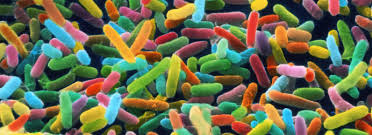
According to Wikipedia, a Microbiome is a bunch of microorganisms that reside in a specific environmental niche. A lot of researchers these days are particularly interested in the various human microbiomes and are busy poking around in places like your nostrils, ear canals, mouth and other nooks and crannies, to see what lives there.
One of the nooks and crannies receiving major airtime is the large intestine or colon, in particular the distal colon or the end closest to your Nethermost Bodily Aperture: NBA for short. The distal colon happens to be home to a thriving community of bacteria, fungi, bacteriophages (viruses which prey on bacteria) and worms, not to mention tiny Radiofrequency Identification or RFID chips implanted in all of us by agents of The Department of Environmental Niches. It is estimated that there are approximately 40 trillion bacterial cells down there amongst the RFID chips.
To put this into the proper perspective, you need to know that the average (human) adult has roughly 10 trillion somatic aka bodily cells. That begs the question of exactly who is the host and who are the “guests”. The other question is, “What the heck can this possibly have to do with Topology?
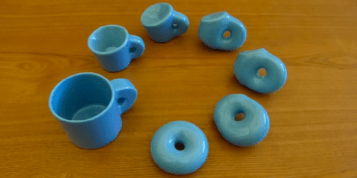
Topology is the branch of Mathematics concerned with “the study of geometric properties and spatial relations unaffected by the continuous change of shape or size of figures” and it comes in handy when you need to answer riddles like “What do a doughnut and a coffee cup have in common?”
Well, if you have a doughnut made of Play DohTM you can squish and deform that doughnut into a coffee cup, as long as you don’t mess around too much with the hole. (A cardinal rule of Topology!)
Thanks to Topology, each of us can be thought of as a long tunnel (with a few side branches) that starts at the mouth and ends at the NBA. The tunnel is surrounded by 10-trillion somatic cells. All of us, including agents of The Department of Environmental Niches, are basically topologically equivalent to a 10-trillion-cell doughnut covered by a layer of icing made up of 40 trillion bacterial cells. This is a highly disturbing thought and actually I don’t even know why I brought it up.

Turns out that this thriving 40 trillion-cell colony of organisms seems to be involved in pretty much every aspect of our existence, including but not limited to: energy harvesting, clearance of toxins, immune function, mood, political preference, the ability to remember what cards have been played in Hearts or Euchre. And so on.
The thing a rational person is going to ask themselves at this point is this: what happens if you take a sample of bacteria from the colon of one person and transplant it into the colon of another person? That is a great question, and you wouldn’t be the first person to ask it. Turns out that these fecal transplants, as they are called, have been carried out to cure intractable diarrhea in people suffering from an overgrowth of a rogue bacterium known as Clostridium difficile.
An even more interesting question you could ask yourself is this: what happens if you take some bacteria from the distal colon of a skinny person and transplant them into the distal colon of a not-so-skinny person? This has already been done in mice and the not-so-skinny mice lost weight without doing anything different such adopting a Paleo diet or taking a GLP1 agonist.
I don’t recommend that you try fecal transplanting at home although you probably could, using just a few common household implements such as a blender and a turkey baster. Who knows where all this is headed? Maybe people will start having fecal-transplant parties, sort of like Tupperware parties, or those parties from the 1950’s that all the Moms brought their kids to so they (the kids) could get chickenpox at the same time.

If you decide on a DIY fecal transplant, you should probably try to find a donor who is a 30 year-old triathlete or maybe someone who is a Pilates instructor who can eat anything she wants for her entire life without gaining a microgram, thereby earning the undying hatred of most of the women on this planet, and maybe even women from other planets.

But if you want to restrict your search for a donor to this planet, Austin might be a great place to start. I know at least two potential donors. Just watch out for those little flying monkeys


 The Department of Lateral Thinking
George,
That was hilarious. Don’t know how you come up with all of this stuff. Now down here in the states all we have to do is turn on C-Span and watch our elected officials. Or if you really want something funny head to the White House.
Best to you,
John\ John Osth CEO, NanoSomiX, Inc. josth@nanosomix.com 949-922-8646
>
LikeLike