
This morning I was fulfilling my duties as the Director of the Arbour Lake Department of Bernese Mountain Dogs, minding my own business and taking my Berner, Sarge, for an emptying, when I encountered someone who had a container hanging on a strap around their neck. The container featured air vents and a clear plastic half-dome windshield. I thought it might have been a re-entry pod or something space-related. From a distance I could see a passenger moving inside and I thought maybe it was a ferret or possibly a stoat. Turns out it was neither.
Anyway, as Sarge and I got closer to the person with a pod slung around her neck, its passenger proved to be a small parrot. The pod sported an official label stating that the parrot was an Emotional Support Animal. I swear on the hem of the robe of Saint Francis of Assisi, Patron Saint of Support Animals, that I am not making any of this up.

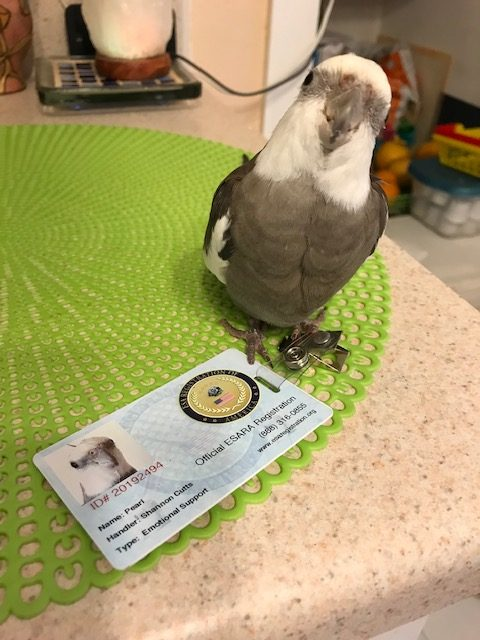
The parrot’s name was Mouse. I think Mouse is an excellent name for an Emotional Support Animal-as long as you don’t have murophobia. Here is another Emotional Support Animal named Pearl. She also happens to be a parrot. Pearl seems to be very pleased to show us her ID card.
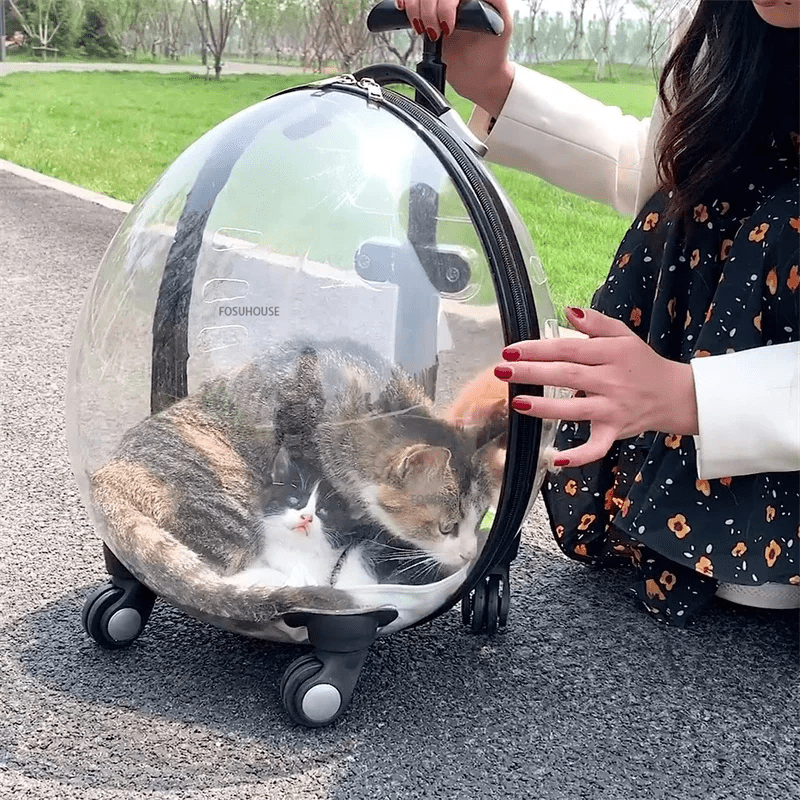
This cat transport pod I ran across in my research is pretty gnarly, so I thought I’d throw it in for good measure. It features a large Primary Cat and a smaller Secondary Cat. The Primary Cat may very well be an Emotional Support Cat to the Secondary Cat. They might both be Emotional Support Cats. Or the larger cat might just be the little cat’s Mom.
In case you were doubting this whole Emotional Support Animal business, what follows is an excerpt from the ESADoctors site. (ESADoctors are advocates for animals and mental health support.)
Emotional Support Animals
Emotional support animals provide individuals with psychiatric or physical disabilities the companionship and emotional support they need to help them navigate daily activities. Emotional support animals do not require any specialized training or certification. There are no restrictions on what animals can be an emotional service animal, only that the animal provides the emotional support an individual requires to live their life. Some of the most common emotional support animals include:
- Dogs
- Cats
- Horses
- Rabbits
- Guinea Pigs
- Birds!
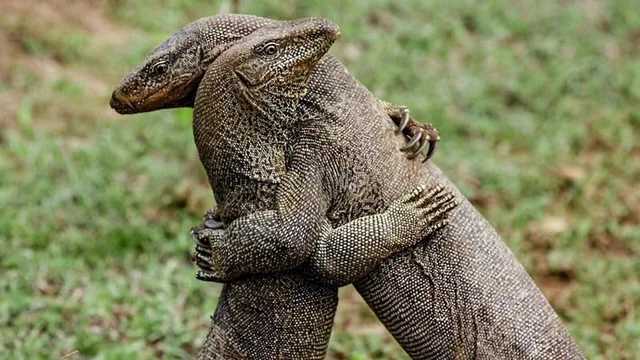
- Reptiles (including Komodo Dragons)
All this got me thinking about this post that I wrote back in 2017: Einstein’s Last Thought Experiment. The reason that post surfaced from the subterranean depths of my memory banks was because it also featured Emotional Support Animals and addressed the age-old question: how do we prevent Emotional Support/Therapy Animal Burnout?
In that post I reasoned that maybe a Therapy Horse approaching burnout could benefit from having a Therapy Dog and that dog would eventually seek the services of a Therapy Cat and the cat would eventually need backstopping from some other species… and so on down the Ladder of Evolution, eventually reaching Therapy Flowers which, in turn, would wind up needing the support of Therapy Bees.
A sidenote on bees:
Bees are notoriously busy creatures: right up there with ants. They’re also puzzling. For example, despite being Socialists, no bee has ever voted Liberal-or Democrat. Bees are artistic. They can perform complicated dances to tell their fellow hive mates the location of the best pollen stashes. In fact, instructional bee-dancing is being considered as an event for the next Summer Olympics.
End of bee side-note.
Where was I?
Yes! In Einstein’s Last Thought Experiment I came up with this conversation between a Therapy Bee and Therapy Bee Spouse:
Therapy Bee: Hi Honey! (pun intended) Bzzz. I’m home!
Therapy Bee Spouse: Bzzz. Bzzz. How was your day? Bzzz.
Therapy Bee: Horrible! Bzzz. My head is so full, it’s buzzing.
Therapy Bee Spouse: Awwww… Bzzz. Here, let me groom your antennae.
Therapy Bee: Hell no! Bzzz. I need a drink!!! Do we have any mead?
Here we are, seven years later and this question remains: when they’re not pollinating the living daylights out of everything in sight, or regulating the temperature of the hive, how do bees relax and avoid burnout if there’s no mead handy?
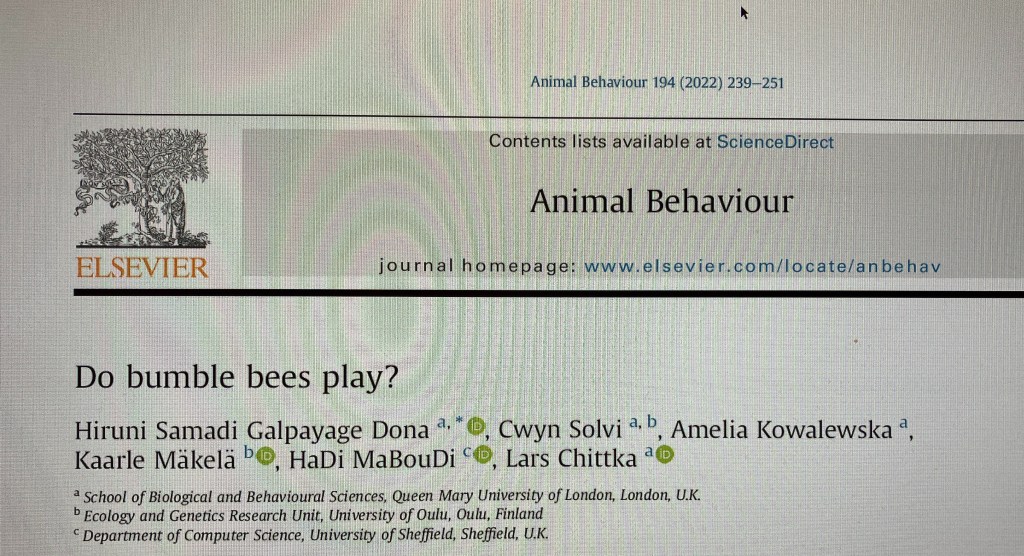
Apparently they play, according to this paper:
The researchers observed male and female bees of different ages beetle around (no pun intended) in various experimental configurations in which the bees would interact with little wooden balls in a variety of settings. They could choose to interact with balls that were free to roll around versus balls that were glued to the floor. They could choose between rooms that had no balls versus rooms that had balls. They could also choose freely between playing with their balls or going straight to a food chamber.
Here’s a diagram of one of the experimental configurations:
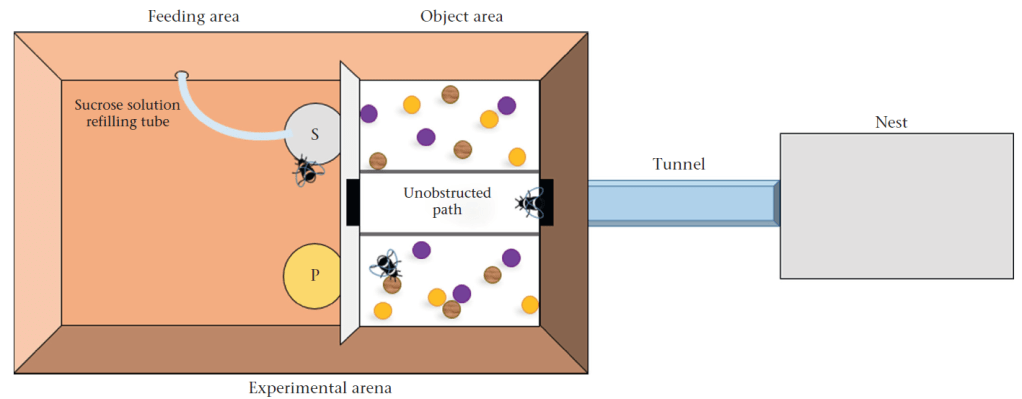
And here’s a short clip in which a playful bee ignores the heckling coming from the Purple Twins on the sideline, sidles up and engages with the tan ball, hip-checks left Purple Twin, dekes around the defensive yellow bottleneck ball that has been glued in place, then circles back to right Purple Twin, beehandles it around and then sets it to spinning like a top with a roundhouse swipe of its left foreleg. Masterful.
Various interesting observations emerged from the full series of experiments. The bees preferred to play more with the balls that rolled. The bees were also less likely to enter a room which they knew to be empty from previous training. The males didn’t try to mate with/extend their genitalia toward the balls and neither sex tried to nibble on the balls and/or probe them. That ruled out lust and hunger as motivations for ball-play. Once the bees found the food room, they still continued to go back to the ball rooms instead of hanging around the kitchen. But as they aged, the males played with their balls more than they foraged but the females foraged more than they played.
I relayed all this excitedly to my wife, Jeanette. The latter observation was the take-home message as far as she was concerned:
Me: All the bees played the most when they were young but the males just kept playing as they grew up.
Jeanette: That figures !
I guess the moral of this story is this: It doesn’t matter whether we’re males at the top of the Animal Kingdom or closer to the bottom. We still like to play with our balls.

 The Department of Lateral Thinking
You waited until the last line to hit the humor home run – but you did it!
Best,
John
John Osth Office: 949-215-6808 Cell: 949-922-8646 jaosth@gmail.com
>
LikeLike